

Genome-supported identification and physiological characterization of Rhodococcus ruber KHA5.2, a hydrocarbon- oxidizing bacterium from Vietnamese coastal sands
Main Article Content
Abstract
Petroleum pollution often involves mixtures of volatile monoaromatic compounds and recalcitrant PAHs, but the isolation and characterization of native hydrocarbon‑degrading microbes in Vietnam are still underexplored. In this study, we isolated and characterized an autochthonous hydrocarbon‑oxidizing bacterium, Rhodococcus ruber KHA5.2, from oil‑impacted coastal sands in Khanh Hoa Province, Vietnam. Species assignment was supported by full‑length 16S rRNA similarity > 99.8% to Rhodococcus spp. and confirmed by digital DNA–DNA hybridization of 99.08% to R. ruber NBRC 15591. Short‑read de novo assembly yielded a 5.43‑Mb draft genome (GC 70.1%) across 981 contigs with 94.72% completeness, consistent with typical Rhodococcus genomes in terms of size and GC content. Experimentally, KHA5.2 oxidized crude oil and representative aromatics spanning BTX constituents (benzene, toluene, xylene) and the low‑molecular‑weight PAH naphthalene. The strain was able to grow at NaCl concentrations up to 5% and across pH 3–11 and 20–40°C; however, hydrocarbon-oxidizing activity, as assessed by the DCPIP reduction assay, was only observed optimally at 0–3% NaCl, indicating that the range of salt tolerance for growth is broader than that for effective oxidative activity. In minimal mineral medium supplemented with 1% (v/v) crude oil, optical density increased to its maximum value on day 6 and then declined, consistent with depletion of readily utilizable fractions and/or accumulation of inhibitory intermediates. The diversity of aromatic compounds oxidized by KHA5.2 matched that observed in closely related Rhodococcus species.. However, these results are based on qualitative assays, and further quantitative evaluation of degradation rates and field trials are needed to fully confirm the strain’s bioremediation capabilities. Taken together, genome-based taxonomy, salinity-tolerant physiology, and qualitative evidence of aromatic substrate oxidation suggest that R. ruber KHA5.2 represents a promising candidate for further bioremediation-oriented investigations in brackish and intertidal settings. To translate laboratory indicators into field‑level performance, standardized experimental conditions and quantitative, mass‑balance measurements (GC–FID/GC–MS) across salinity gradients and environmental matrices will be essential.
Keywords
Bioremediation, BTX biodegradation, Crude oil degradation, Hydrocarbon-degrading enzymes, Rhodococcus ruber KHA5.2, Whole-genome sequencing
Article Details

This work is licensed under a Creative Commons Attribution 4.0 International License.
Introduction
Petroleum hydrocarbons and their volatile aromatic fractions, collectively referred to as BTEX (benzene, toluene, ethylbenzene and xylenes), are widespread environmental contaminants arising from oil production, transport and accidental releases (Wongbunmak et al., 2020). BTEX compounds pose acute and chronic risks to human health and ecosystems - benzene is a well‑established human carcinogen, while toluene, ethylbenzene and xylenes cause neurotoxic and hematologic effects - and their physicochemical properties (high mobility in the subsurface and affinity for groundwater) make them particularly challenging to contain (Laczi et al., 2015; Wongbunmak et al., 2020). Concurrently, heavier and more hydrophobic fractions of crude oil, such as polycyclic aromatic hydrocarbons (PAHs), persist in soils and sediments through strong sorption to organic matter and low aqueous solubility, creating a complex contaminant mixture that demands remediation strategies capable of addressing both labile and recalcitrant compounds (Al Otibi et al., 2022; Babaarslan et al., 2003).
Biological attenuation caused by native or adapted microorganisms is an environmentally friendly and cost‑effective approach for the remediation of petroleum‑contaminated sites (Yu et al., 2022; Zaman et al., 2025; Chaudhary & Kim, 2018). Members of the genus Rhodococcus are notable candidates for bioremediation because of their metabolic versatility, ecological resilience and frequent carriage of large, plastic genomes that encode diverse oxygenases, dehydrogenases and accessory systems (Delegan et al., 2022; Pathak et al., 2016). These features enable many Rhodococcus strains to transform a wide spectrum of hydrocarbons, including n‑alkanes, BTEX and PAHs (Li et al., 2016; Auffret et al., 2009). In addition, production of extracellular polymers and biosurfactants can enhance pollutant bioavailability, further supporting degradation in heterogeneous environmental matrices (Iwabuchi et al., 2002; Sharma et al., 2025).
Despite the recognized metabolic versatility and ecological resilience of Rhodococcus species in degrading a wide range of hydrocarbons, comprehensive genomic information and detailed degradation pathways of indigenous Rhodococcus strains isolated from Vietnam remain largely unexplored (Le et al., 2018; Tran et al., 2023). The scarcity of integrative studies combining whole-genome sequencing with experimental validation of BTEX (hereafter referred to as BTX in this study, excluding ethylbenzene) and crude oil biodegradation limits the understanding of native microbial communities’ potential for bioremediation in this geographical context (Auffret et al., 2009; Bukliarevich et al., 2023; Li et al., 2016; Pizzul et al., 2007). This knowledge gap impedes the development of effective, tailored bioremediation strategies appropriate for contaminated sites within Vietnam’s unique environmental settings.
The objectives of this study were to (i) isolate and identify the indigenous strain KHA5.2; (ii) sequence and analyze its genome; and (iii) experimentally validate its capacity to broad substrate range for hydrocarbon oxidation. By fulfilling these objectives, this work not only contributes novel genomic insights into indigenous Rhodococcus strains from Vietnam but also lays the groundwork for future application of these bacteria in bioremediation technologies aimed at mitigating petroleum hydrocarbon pollution in local environments.
Materials and Methods
Research materials
Oil-contaminated soil samples were collected from the coastal area of Khanh Hoa Province, Vietnam, between November 2023 and March 2024. At each survey site, three composite soil samples were taken from the surface down to 120 cm depth, collected from representative locations of coastal sandy land. Sampling was carried out using a sharp-edged steel cylinder manually driven into the soil to obtain intact samples (Margesin et al., 2011). After collection, samples were stored in a cold box at approximately 4-10°C and transported to the Microbiology Laboratory, Department of Biotechnology, Joint Vietnam-Russia Tropical Science and Technology Research Center for analysis. Using this method, a mixed composite sample was prepared to serve as the native inoculum for enrichment cultures in the laboratory.
Research methodology
Isolation and culture conditions
Bushnell-Haas Broth (BHB) medium (M350-500G/Himedia) supplemented with 5% (v/v) crude oil-diesel mixture (5:95) was used for the inoculation of soil samples and the isolation of bacterial consortia, following the method described by Satpute (2010) (Satpute et al., 2010). To select for halotolerant isolates, NaCl was adjusted to 3% (w/v) during the first enrichment cycle. After 7 days of incubation, the enriched culture was extracted and transferred to the same fresh medium at a ratio of 10% (v/v). For the identification of bacterial isolates of the consortium, a 100-μL aliquot of the third culture was used for serial dilutions, and aliquots (100 μL) of 10-4 to 10-6 dilutions were plated on Bushnell-Haas Agar medium (M349-500G/Himedia), addition 1.5% NaCl and 1% crude oil. The plates were incubated for 2 days at 30°C. The morphologically-distinct colonies were observed, all of which were newly streaked in nutrient agar plates for purification. The growth and hydrocarbon-degrading capacity of the KHA5.2 strain was evaluated in BHB medium (Muriel Millán et al., 2019).
Morphological and biochemical characterization
Morphologically distinct colonies were selected and purified by repeated streaking on nutrient agar plates. KHA5.2 cells were observed by using light microscopy, Gram staining and scanning electron microscopy (SEM). Gram's reaction of strain KHA5.2 was determined by using Gram staining kit (Himedia). The growth of strain KHA5.2 at various temperatures (20-45°C), at different NaCl concentrations (0-10%) and at different pH range (2.0-11.0) was tested in LB medium. pH was maintained using 50 mM citrate (pH 2-5), phosphate (pH 6-8), and glycine-NaOH (pH 9-11) buffers, and verified both before inoculation and after incubation. Cultures were inoculated at an initial OD600nm of 0.05 and incubated for 24 hours at 30°C with shaking at 150 rpm. All experiments were performed in biological triplicate. Crude-oil biodegradation was evaluated across different NaCl concentrations in BHB medium using the DCPIP reduction assay as a proxy for hydrocarbon-oxidizing activity results (Al Otibi et al., 2022).
16S rRNA Gene Sequence and phylogenetic analysis
Bacterial DNA was extracted from the isolates using the ZR Fungal/Bacterial DNA MiniPrep according to the manufacturer’s protocol. The resulting DNA typically exhibited A260/A280 > 1.8 with yields up to 25 µg, suitable for PCR analyses.
16S rRNA PCR amplification and Sanger sequencing: The 16S rRNA gene was amplified via PCR with the universal primer pair 27F (5′-AGAGTTTGATCATGGCTCAG-3′, forward primer) and 1492R (5′-TACGGYTACCTTGTTACGACTT-3′, reverse primer) to produce a DNA fragment of 1500 base pairs was used in conventional PCR (Salman et al., 2018). PCR mixture without DNA template (non-template negative control) was used as a negative control. The 16S rRNA gene, the thermocycling fragments were amplified in the Thermal Cycler for DNA amplification (GeneAmp™ PCR System 9700, Life Technologies Applied Biosystems, Singapore). Programmed PCR was performed as follows: initial denaturation step of 94°C for 5 min, followed by 30 cycles of 94°C for 1 min, primer annealing at 52°C for 1 min, and extension at 72°C for 1.5 min, finally, extension incubated at 72°C for 5 min. The amplified PCR product was resolved by electrophoresis on 1% agarose gel and sent for directly automated sequencing by using Macrogen sequencing facility (Macrogen Inc., Seoul, Korea) and the data obtained were matched with the online database using BLAST. The phylogenetic tree was computed by using the neighbor-joining method with 1000 bootstrap replicates in MEGA version 7.0 (Quach et al., 2021).
Genomic Analysis
Genomic DNA was extracted from cultured cells using the QIAamp DNA Mini Kit (Qiagen, USA) according to the manufacturer’s protocol. DNA concentration was measured fluorometrically with a Qubit fluorometer (Thermo Fisher Scientific) and sent for analysis to KTest Science Company Limited, Vietnam.
Whole‑genome sequencing libraries were prepared using NEBNext dsDNA Fragmentase and the NEBNext Ultra II DNA Library Prep Kit for Illumina (New England Biolabs, USA) following the manufacturer’s instructions. Library concentration was quantified with Qubit and the average library fragment size was determined on an Agilent 2100 Bioanalyzer (Agilent Technologies) in accordance with Illumina library quality guidelines. Qualified libraries were sequenced as paired‑end 150 bp (2×150) reads on the ONSO platform (Pacbio).
Raw sequencing data were cleaned using the tool fastp v0.23.1 (Chen et al., 2018). Nucleotides with poor quality, unreliable, or undetermined bases (N-type nucleotides) were removed based on the Phred-score values recorded for each nucleotide (Illumina). Reads that passed the cleaning process were assembled de novo using the tool Unicycler v0.4.8 (Wick et al., 2017). The quality of the de novo assembly was evaluated using Quast v5.2.0 (Gurevich et al., 2013) and by locally aligning reads onto the assembled contigs. This approach allows the detection of regions with abnormally low coverage compared to neighboring regions, which need to be considered in the assembly results. Finally, the tool checkM v1.2.1 (Parks et al., 2015) was used to assess the quality and completeness of the assembly results. The assembly was then annotated using the Prokka v1.14.6 annotation system specialized for the target bacterial genus to annotate the assembled contigs (Seemann, 2014). Identification of the target bacteria was performed using the tool gtdbtk (v2.1.1) and the updated GTDB database specialized for prokaryotes (Chaumeil et al., 2020).
ANI comparison, average nucleotide identity (ANI) was conducted to measure the overall similarity between Rodococcus genome sequences using OrthoANI with default parameters. Heat map was generated with OrthoANI values that were calculated from Orthologous Average Nucleotide Identity Tool (Lee et al., 2016).
Assessment of hydrocarbon‑oxidizing activity using the DCPIP assay
Hydrocarbon-oxidizing activity was assessed using a modified DCPIP (2,6-dichlorophenol indophenol) assay, which serves as an indicator of metabolic activity toward hydrocarbons rather than a direct quantitative measure of oil degradation. The procedure was as follows: 100 mL of sterilized BHB medium was added with crude oil at a ratio of 1% (v/v) or naphthalene/benzene/toluene/xylene at a concentration of 50 mg/L, along with 0.1% Tween 80 and the redox indicator DCPIP at a concentration of 0.6 mg/mL. Next, 1 mL of 24-hour culture medium of KHA5.2 strain was added to each bottle containing the above solution and incubated at 30°C for 7 days, with shaking speed of 150 rpm. The test bottles were tightly sealed and protected from light to minimize evaporation and photooxidation. Tween 80 was used to stimulate the metabolic activity of bacteria as a biosurfactant and Tween 80 hydrolysis. The negative control group was a similarly prepared bacteria-free medium for comparison.
To ensure rigorous interpretation of hydrocarbon utilization and rule out Tween 80 as a possible sole carbon source, several parallel controls were established: The negative control group was a similarly prepared bacteria-free medium for comparison. Additionally, a parallel control was conducted which excluded the hydrocarbon substrate but contained all other components, including 0.1% (v/v) Tween 80 (with or without bacterial inoculum as needed). This control specifically assessed whether Tween 80 could support DCPIP reduction. The color change of the medium was evaluated visually for all treatments: a colorless appearance indicated positive hydrocarbon-oxidizing activity (reduced DCPIP), while a blue color indicated negative activity (oxidized DCPIP). To avoid potential conflict between DCPIP monitoring and bacterial growth quantification, all cell growth (OD600nm) measurements were conducted using samples prepared under identical conditions but without the addition of DCPIP. All experiments were performed with three independent replicates to ensure the objectivity of the results (Al-Otibi et al., 2022; Bučková et al., 2013).
Data analysis
The growth curve was constructed by measuring optical density at 600 nm (OD600nm) daily for 7 days in BHB medium supplemented with 1% (v/v) crude oil. Each point on the graph represents the mean OD600nm of three independent replicates with standard deviation error bars. Differences in OD600nm over time were analyzed using one-way ANOVA with culture time (Day) as a fixed factor, based on raw data (n = 3 per day), using R software, version 4.5.2, 2025-10-.
Results
Isolation of strain KHA5.2
KHA5.2 strain was isolated from an enriched culture of contaminated soil samples collected in the coastal area of Cam Ranh, Khanh Hoa, using Bushnell-Haas agar. Cells of strain KHA5.2 were Gram-positive, rod-shaped (Figure 1.B, C). After 24 h of aerobic growth in LB agar at 30°C, colonies were yellow in color (Figure 1.A). The strain KHA5.2 showed growth at 20-40°C temperature, at pH range 3-11, and tolerance of NaCl up to 5% in LB culture after 24 hours at 150 rpm shaking. No growth was observed at 45°C, pH ≤ 2 and ≥ 11, and at NaCl concentrations ≥ 6%.
Strain KHA5.2 showed the ability to utilize crude oil as the sole carbon source when cultured in BHB minimal mineral medium supplemented with 1% (v/v) crude oil. The growth process was clearly demonstrated by the increase in OD value at 600 nm, reaching a maximum on the sixth day, and then it gradually decreased, supporting the ability of the strain to utilize and oxidize components of crude oil to support growth (Figure 2.A). The ANOVA results showed that incubation time had a highly significant effect on OD600 (Day: df = 6, F = 51,28, p < 0,001). The residual sum of squares of the model was very small, indicating that random error among replicates was low compared with the variability over time. Crude oil degradation by strain KHA5.2 was clearly observed when testing DCPIP oxidation ability in the salinity range of 0-3%, while the oxidizing activity decreased significantly at 4% salinity and no blue color loss was detected at higher concentrations (Figure 2.B,C).
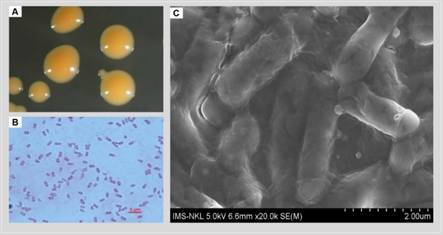
Figure 1. Colony morphology (A), Gram staining (B) and SEM photographs (C) of the isolated bacterium KHA5.2
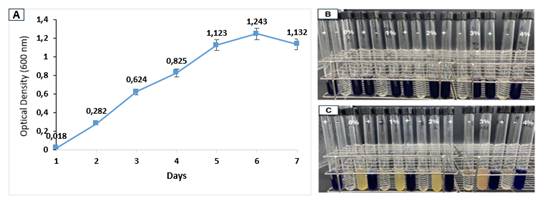
Figure 2. Estimation of growth on minimal broth supplemented with crude oil and DCPIP-based assessment of hydrocarbon-oxidizing activity by strain KHA5.2 across NaCl concentrations of 0-4% (w/v)
(A) Microbial growth curve expressed as OD600nm in BHB medium containing 1% (v/v) crude oil after 7 days of incubation (mean ± SD, n=3). (B) and (C) show the crude‑oil–oxidizing activity, which was assayed in BHB supplemented with 0.1% (v/v) Tween 80 and 0.6 mg/mL DCPIP. Panel (B) shows results at day 0 (control) and (C) at day 4. (+) Positive and (–) negative controls are represented at the corresponding salt concentrations.
Identification of strain KHA5.2
The 16S rRNA gene sequence of strain KHA5.2 was deposited in GenBank (NCBI) under accession number PV848634, with a length of 1,520 bp. The closest BLAST matches of the strain were Rhodococcus ruber strain DSM 43338T (Accession no. LRRL01000064) and R. aetherivorans 10bc312 (Accession no. NR_025208) with over 99.8% sequence similarity (Figure 3). This result further confirmed the classification of KHA5.2 as belonging to the genus Rhodococcus.
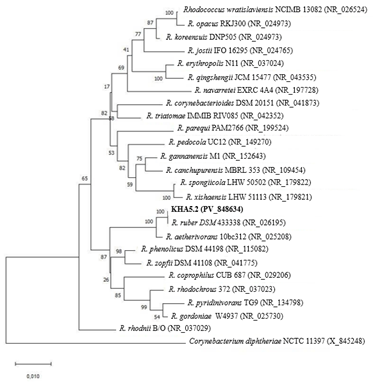
Figure 3. Neighbor-joining tree based on 16S rRNA gene sequences showing phylogenetic relationship between Rhodococcus sp. KHA5.2 and its closely related phylogenetic neighbors, constructed through MEGA version 7.0. Numbers at nodes represent bootstrap values obtained with 1,000 replications. Bar 0.01 indicates 1% nucleotide substitution; The sequence of Corynebacterium diphtheriae NCTC 11397 was used as the outgroup.
Draft genome and taxonomic identification of strain KHA5.2
The draft genome of strain KHA5.2 comprises 5,430,845 bp with a Q30 score of 93.6%, indicating high base‑calling accuracy. De novo assembly yielded 981 contigs totaling 5.43 Mbp, with a largest contig of 48,449 bp and assembly metrics of N50 = 8,263 bp and L50 = 198. The largest contig received 20,986 plus and 21,080 minus reads, and the average sequence coverage across contigs ranged from ~0.35× to >7×, reflecting relatively low and uneven depth. Consistent with this, the assembly is highly fragmented (981 contigs, N50 ~8 kb) despite an estimated completeness of 94.72%, which may limit the resolution of fine‑scale genomic features in downstream analyses. The genome has an average GC content of 70.1%, and additional sequencing and/or hybrid assembly would likely improve contiguity and completeness.
Pairwise genome comparisons using the Genome-to-Genome Distance Calculator (GGDC), employing Formula 2 optimized for draft genomes, revealed high digital DNA–DNA hybridization (dDDH) values of 99.08% between strain KHA5.2 and R. ruber NBRC 15591 (GCF_001894945.1) (Figure 4). These values strongly support the assignment of strain KHA5.2 to the species R. ruber. Although the current assembly is fragmented and of suboptimal completeness, the digital genome similarity convincingly meets species-level thresholds. Despite its fragmented nature, the current draft genome provides sufficient genome-wide similarity metrics (ANI and dDDH) to support classification of the strain as R. ruber KHA5.2. The observed ANI value (99.14%) is well above the widely accepted species threshold of 95-96%, further confirming species-level assignment.
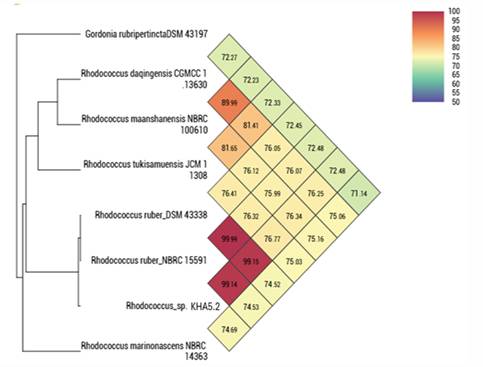
Figure 4. Phylogenetic classification of Rhodococcus sp. KHA5.2 based on a heatmap of OrthoANI values among strain KHA5.2 and six closely related species.
Broad substrate range for the oxidation of aromatic hydrocarbons by R. ruber strain KHA5.2
To characterize the substrate range for aromatic hydrocarbons oxidation, we compared the strain R. ruber KHA5.2 with related strains within the genus Rhodococcus, including R. aetherivorans IAR1, R. wratislaviensis IFP 2016, and R. aetherivorans IFP 2017. Table 1 summarizes the oxidation (DCPIP) responses of these strains across a representative set of substrates (benzene, toluene, xylene, naphthalene), with “+” indicating oxidative capability and “N/A” indicating data not available. A control containing only Tween 80 (BHB + 0.1% Tween 80 without hydrocarbon) showed no DCPIP decolorization, indicating Tween 80 did not affect the indicator. These results provide a comparative context for determining the breadth of the substrate range of KHA5.2 relative to the reference strains.
Table 1. Broad substrate range for hydrocarbon oxidation by R. ruber strain KHA5.2 and related species belonging to the genus Rhodococcus
Substrates/ Response | R. ruber KHA5.2 | R.aetherivorans IAR1 [31] | R.wratislaviensis IFP 2016 [11] | R.aetherivorans IFP 2017 [11] |
Benzene | + | + | + | + |
Toluene | + | N/A | + | + |
Xylene | + | + | + | + |
Naphthalene | + | - | + | + |
Discussion
This study reports the isolation and biological characterization of an indigenous hydrocarbon‑oxidizing bacterium from the coastal zone of Khanh Hoa, Vietnam, designated R. ruber KHA5.2. Full‑length 16S rRNA sequencing of KHA5.2 (~1.5 kb; primers 27F/1492R; GenBank: PV848634) provides a reliable basis for taxonomic inference at the genus level. BLAST searches returned the closest matches to the type strains R. ruber DSM 43338 and R. aetherivorans 10bc312, supporting assignment to the genus Rhodococcus. Because 16S rRNA is highly conserved within this genus, with many species exhibiting ≥99% sequence identity, it primarily supports genus‑level placement and guides species‑level hypotheses rather than resolving species unambiguously. Whereas genome‑based digital DNA-DNA hybridization (dDDH; GGDC) yielded 99.08% similarity to R. ruber NBRC 15591, providing decisive species‑level evidence. ANI analysis showed that strain KHA5.2 shared 99.14% nucleotide identity with Rhodococcus ruber, together providing compelling evidence that KHA5.2 belongs to this species. Although the current assembly is fragmented (981 contigs; 94.72% completeness), the read quality metrics and GC content 70.1% are consistent with Rhodococcus genomes, permitting a reliable interim classification pending a higher‑quality assembly. However, this fragmented nature represents a limitation that may affect detailed analysis of genomic architecture, including operon structures, mobile genetic elements, and gene synteny, pending a higher quality assembly.
The genus Rhodococcus has long been recognized as bioremediating genera, owing to its diverse enzymatic systems and high adaptability to harsh environmental conditions (Chaudhary & Kim, 2018; Iwabuchi et al., 2002; Laczi et al., 2015; Peng et al., 2007). Strain KHA5.2 exhibited significant tolerance to a wide pH range (3-11) and temperatures (20-40°C). The ability to survive and remain active in highly acidic (pH 3) and alkaline (pH 11) environments is a significant advantage for field applications, where the pH of contaminated sites can fluctuate dramatically. This is also consistent with the isolation of other highly degradative strains such as R. olei from oil-contaminated soil (Chaudhary & Kim, 2018), thereby further strengthening the strategy of searching for potential strains from chronically contaminated environments.
The most notable physiological trait of strain KHA5.2 is its halotolerance. The strain not only survived but also exhibited optimal hydrocarbon-oxidizing activity at NaCl concentrations ranging from 0-3%. This is consistent with its isolation source, a coastal region at the interface of freshwater and saltwater. While numerous studies have reported on hydrocarbon-degrading Rhodococcus strains from marine environments (Iwabuchi et al., 2002), the identification of an indigenous strain, pre-adapted to the ecological conditions of Vietnam, holds significant practical relevance. The effective performance in saline conditions makes KHA5.2 a promising candidate for remediating marine oil spills or estuarine pollution, which remains a challenge for many other microbial agents.
Strain KHA5.2 showed the ability to utilize crude oil as the sole carbon source when cultured in BHB minimal mineral medium supplemented with 1% (v/v) crude oil. The growth process was clearly demonstrated by the increase in OD600nm, which reached a maximum on the sixth day and then gradually decreased, confirming the ability of the strain to degrade and metabolize crude oil components to support its growth (Figure 2A). Consistently, the ANOVA results showed that cell density (OD600nm) changed markedly over time, reflecting a typical growth pattern of the strain under the experimental culture conditions. The very large -value and extremely small -value indicate that the growth trend over time was highly consistent among replicates, thereby confirming the high reliability of the obtained growth curve. Since the culture medium contained only mineral salts and 1% (v/v) crude oil, the observed growth clearly demonstrates that this strain is capable of utilizing and degrading crude oil as a source of carbon and energy.
However, it is important to note that while KHA5.2 was able to grow at up to 5% NaCl, its hydrocarbon-oxidizing activity decreased sharply at 4% NaCl and above. This difference between the range of tolerance for growth and for oxidative activity likely results from physiological and enzymatic mechanisms. Under high osmotic stress, the bacterium must allocate more resources for osmoprotection (e.g., synthesis of compatible solutes and membrane stabilization), which can reduce the expression or catalytic efficiency of hydrocarbon-oxidizing enzymes. Additionally, salinity-induced changes in membrane properties and cellular regulation may hinder the uptake of hydrophobic substrates or the expression of catabolic genes, thus limiting oxidative activity even when growth persists (Iwabuchi et al., 2002; Muriel Millán et al., 2019). These mechanisms are consistent with previous findings in Rhodococcus and other hydrocarbon-degrading bacteria.
In this study, the ability of KHA5.2 to utilize various hydrocarbons was preliminarily screened using the DCPIP redox indicator method (Auffret et al., 2009; Hori et al., 2009). It must be acknowledged that this method is indicative only of metabolic activity (i.e., respiration) in the presence of a substrate, rather than direct quantitative evidence of degradation (Al-Otibi et al., 2022; Bučková et al., 2013). Nevertheless, the decolorization of DCPIP in the presence of crude oil, BTX, and naphthalene suggests a broad substrate range for KHA5.2, encompassing complex alkanes in crude oil as well as monocyclic (BTX) and polycyclic (naphthalene) aromatic compounds. This capability is a hallmark of the Rhodococcus genus, which is known to possess multiple oxidative enzyme systems, including alkane monooxygenases and cytochrome P450s, allowing it to attack a wide variety of hydrocarbons (Laczi et al., 2015; Peng et al., 2007). For instance, other Rhodococcus strains have been shown to co-metabolize BTEX and utilize naphthalene as a sole carbon source (Auffret et al., 2009; Hori et al., 2009). Therefore, our screening results, while qualitative, provide an initial indication of the metabolic potential of KHA5.2 and serve primarily to prioritize this strain for subsequent quantitative analyses.
The main limitation of this work is the qualitative nature of the degradation assessment. Future research should therefore prioritize the quantification of hydrocarbon degradation rates using standard methods (GC-MS, gravimetric analysis). Concurrently, genomic analysis should be employed to identify the catabolic genes responsible for this activity. Finally, optimizing environmental parameters and validating the strain's performance in microcosm studies are crucial steps toward its practical application.
In summary, this study has elucidated the fundamental yet critical characteristics of an indigenous R. ruber strain with high tolerance and a broad spectrum of activity against various hydrocarbons. Although more quantitative studies are required, these initial findings indicate, at a preliminary screening level, that R. ruber KHA5.2 is a promising candidate for further evaluation as a bioremediation agent, particularly within marine and coastal ecosystems of Vietnam.
Conclusion
This study isolated and characterized R. ruber KHA5.2, an indigenous bacterium from oil-contaminated coastal sands in Khanh Hoa, Vietnam. Genome-based taxonomic analysis, including 16S rRNA sequencing and digita l DNA-DNA hybridization (dDDH), confirmed the identity of the strain as R. ruber. Physiological assessments demonstrated that R. ruber KHA5.2 is tolerant to a wide range of environmental conditions, including temperatures of 20-40°C, pH levels from 3-11, and NaCl concentrations up to 5%. Furthermore, the strain displayed qualitative oxidative responses toward a broad range of aromatic hydrocarbons, including crude oil, BTX (benzene, toluene, xylene), and naphthalene, as assessed by preliminary screening assays. Its oxidative activity was optimal under mildly saline conditions (0-3% NaCl), which is consistent with the characteristics of its native intertidal habitat. However, these results are based on qualitative assays, and further quantitative evaluation of degradation rates and field trials are needed to fully confirm the strain’s bioremediation capabilities.
Acknowledgments: This research was supported by the Joint Vietnam-Russia Tropical Science and Technology Research Center (No. SH.Đ1.04/23). We would like to thank the Institute of Biology, Vietnam Academy of Science and Technology and the KT‑Grant (KTest) program (No. KT‑GRANT 2024‑01) for supporting genome data analysis.
Statement on the use of Generative AI: The authors declare that AI tools were used only for language editing/formatting, and not for generating scientific content. All data, analyses, and interpretations were performed and verified by the authors, who take full responsibility for the manuscript.
Author contributions: Bui Thu Hang: Writing-original draft preparation, Laboratory experiments; Do Thi Tuyen: Genome data analysis, review and editing; Tran Thi Thanh Thuy: Collection of oil‑contaminated soil samples; Nguyen Viet Cuong, Nguyen Thi Kim Thanh: Laboratory experiments; Ngo Cao Cuong: Review and project administration.
Conflict of interest statement:The authors declare that there are no conflicts of interest related to this article.
References
Al-Otibi, F., Al-Zahrani, R. M., & Marraiki, N. (2022). The crude oil biodegradation activity of Candida strains isolated from oil-reservoirs soils in Saudi Arabia. Scientific reports, 12(1), 10708. https://doi.org/10.1038/s41598-022-14836-0
Auffret, M., Labbé, D., Thouand, G., Greer, C. W., & Fayolle-Guichard, F. (2009). Degradation of a mixture of hydrocarbons, gasoline, and diesel oil additives by Rhodococcus aetherivorans and Rhodococcus wratislaviensis. Applied and environmental microbiology, 75(24), 7774–7782. https://doi.org/10.1128/AEM.01117-09
Babaarslan, Ç., Tekeli, A., & Mehmetoğlu, T. (2003). Biodegradation of BTEX compounds by a mixed culture obtained from petroleum formation water. Energy Sources, 25(7), 733–742. https://doi.org/10.1080/00908310390212408
Bučková, M., Puškarová, A., Chovanová, K., Kraková, L., Ferianc, P., & Pangallo, D. (2013). A simple strategy for investigating the diversity and hydrocarbon degradation abilities of cultivable bacteria from contaminated soil. World journal of microbiology & biotechnology, 29(6), 1085–1098. https://doi.org/10.1007/s11274-013-1277-5
Bukliarevich, H. A., Gurinovich, A. S., Filonov, A. E., Akhremchuk, A. E., Puntus, I. F., & Boronin, A. M. (2023). Molecular genetic and functional analysis of the genes encoding alkane 1-monooxygenase synthesis in members of the genus Rhodococcus. Microbiology, 92(2), 242–255. https://doi.org/10.1134/S0026261722603311
Chaudhary, D. K., & Kim, J. (2018). Rhodococcus olei sp. nov., with the ability to degrade petroleum oil, isolated from oil-contaminated soil. International journal of systematic and evolutionary microbiology, 68(5), 1749–1756. https://doi.org/10.1099/ijsem.0.002750
Chaumeil, P. A., Mussig, A. J., Hugenholtz, P., & Parks, D. H. (2019). GTDB-Tk: a toolkit to classify genomes with the Genome Taxonomy Database. Bioinformatics (Oxford, England), 36(6), 1925–1927. Advance online publication. https://doi.org/10.1093/bioinformatics/btz848
Chen, S., Zhou, Y., Chen, Y., & Gu, J. (2018). fastp: an ultra-fast all-in-one FASTQ preprocessor. Bioinformatics (Oxford, England), 34(17), i884–i890. https://doi.org/10.1093/bioinformatics/bty560
Cong, L. T. N., Mai, C. T. N., Huy, V. N., Lien, D. T., Uyen, D. T. T., Minh, N. T., & Ha, H. P. (2018). Enhancement diesel oil degradation by using biofilm forming bacteria on biochar. Journal of Vietnamese Environment, 9(1), 26–31. https://doi.org/10.13141/jve.vol9.no1.pp26-31
Delegan, Y., Petrikov, K., Frantsuzova, E., Rudenko, N., Solomentsev, V., Suzina, N., Travkin, V., & Solyanikova, I. P. (2022). Complete Genome Analysis of Rhodococcus opacus S8 Capable of Degrading Alkanes and Producing Biosurfactant Reveals Its Genetic Adaptation for Crude Oil Decomposition. Microorganisms, 10(6), 1172. https://doi.org/10.3390/microorganisms10061172
Gurevich, A., Saveliev, V., Vyahhi, N., & Tesler, G. (2013). QUAST: quality assessment tool for genome assemblies. Bioinformatics (Oxford, England), 29(8), 1072–1075. https://doi.org/10.1093/bioinformatics/btt086
Hori, K., Kobayashi, A., Ikeda, H., & Unno, H. (2009). Rhodococcus aetherivorans IAR1, a new bacterial strain synthesizing poly(3-hydroxybutyrate-co-3-hydroxyvalerate) from toluene. Journal of bioscience and bioengineering, 107(2), 145–150. https://doi.org/10.1016/j.jbiosc.2008.10.005
Iwabuchi, N., Sunairi, M., Urai, M., Itoh, C., Anzai, H., Nakajima, M., & Harayama, S. (2002). Extracellular polysaccharides of Rhodococcus rhodochrous S-2 stimulate the degradation of aromatic components in crude oil by indigenous marine bacteria. Applied and environmental microbiology, 68(5), 2337–2343. https://doi.org/10.1128/AEM.68.5.2337-2343.2002
Jabbar Salman, H., Hesnaa Saeed, M., Nada Mohammed, T., & Abbas, A. A. (2018). Isolation and Identification of bacterial species in neonatal sepsis using Polymerase Chain Reaction-Based 16S rRNA Sequencing. Journal of Pharmaceutical Sciences and Research, 10(6), 1508-10.
Laczi, K., Kis, Á., Horváth, B., Maróti, G., Hegedüs, B., Perei, K., & Rákhely, G. (2015). Metabolic responses of Rhodococcus erythropolis PR4 grown on diesel oil and various hydrocarbons. Applied microbiology and biotechnology, 99(22), 9745–9759. https://doi.org/10.1007/s00253-015-6936-z
Lee, I., Ouk Kim, Y., Park, S. C., & Chun, J. (2016). OrthoANI: An improved algorithm and software for calculating average nucleotide identity. International journal of systematic and evolutionary microbiology, 66(2), 1100–1103. https://doi.org/10.1099/ijsem.0.000760
Li, C., Zhang, C., Song, G., Liu, H., Sheng, G.H., Ding, Z., Wang, Z., Sun, Y., Xu, Y., & Chen, J. (2015). Characterization of a protocatechuate catabolic gene cluster in Rhodococcus ruber OA1 involved in naphthalene degradation. Annals of Microbiology, 66, 469 - 478. https://doi.org/10.1007/s13213-015-1132-z
Margesin, R., Płaza, G. A., & Kasenbacher, S. (2011). Characterization of bacterial communities at heavy-metal-contaminated sites. Chemosphere, 82(11), 1583–1588. https://doi.org/10.1016/j.chemosphere.2010.11.056
Muriel Millán, L. F., Rodríguez-Mejía, J. L., Godoy-Lozano, E. E., Rivera-Orduña, F. N., Gutiérrez-Ríos, R. M., Morales-Guzmán, D., Segovia, L., & González-Pedrajo, B. (2019). Functional and genomic characterization of a Pseudomonas aeruginosa strain isolated from the southwestern Gulf of Mexico reveals an enhanced adaptation for long chain alkane degradation. Frontiers in Marine Science, 6, Article 572. https://doi.org/10.3389/fmars.2019.00572
Parks, D. H., Imelfort, M., Skennerton, C. T., Hugenholtz, P., & Tyson, G. W. (2015). CheckM: assessing the quality of microbial genomes recovered from isolates, single cells, and metagenomes. Genome research, 25(7), 1043–1055. https://doi.org/10.1101/gr.186072.114
Pathak, A., Chauhan, A., Blom, J., Indest, K. J., Jung, C. M., Stothard, P., Bera, G., Green, S. J., & Ogram, A. (2016). Comparative Genomics and Metabolic Analysis Reveals Peculiar Characteristics of Rhodococcus opacus Strain M213 Particularly for Naphthalene Degradation. PloS one, 11(8), e0161032. https://doi.org/10.1371/journal.pone.0161032
Peng, F., Liu, Z., Wang, L., & Shao, Z. (2007). An oil-degrading bacterium: Rhodococcus erythropolis strain 3C-9 and its biosurfactants. Journal of applied microbiology, 102(6), 1603–1611. https://doi.org/10.1111/j.1365-2672.2006.03267.x
Pizzul, L., del Pilar Castillo, M., & Stenström, J. (2007). Effect of rapeseed oil on the degradation of polycyclic aromatic hydrocarbons in soil by Rhodococcus wratislaviensis. International biodeterioration & biodegradation, 59(2), 111-118. https://doi.org/10.1016/j.ibiod.2006.08.004
Quach, N.T., Vu, T.H.N., Nguyen, N.A. et al. Phenotypic features and analysis of genes supporting probiotic action unravel underlying perspectives of Bacillus velezensis VTX9 as a potential feed additive for swine. Ann Microbiol 71, 36 (2021). https://doi.org/10.1186/s13213-021-01646-4
Satpute, S. K., Banpurkar, A. G., Dhakephalkar, P. K., Banat, I. M., & Chopade, B. A. (2010). Methods for investigating biosurfactants and bioemulsifiers: a review. Critical reviews in biotechnology, 30(2), 127–144. https://doi.org/10.3109/07388550903427280
Seemann T. (2014). Prokka: rapid prokaryotic genome annotation. Bioinformatics (Oxford, England), 30(14), 2068–2069. https://doi.org/10.1093/bioinformatics/btu153
Sharma, S., Patel, K., Shaikh, S., Madamvar, D., & Desai, C. (2025). Biochemical characterization of a novel lipopeptide biosurfactant produced by Rhodococcus pyridinivorans SK12 and its application in crude oil biodegradation. Geomicrobiology Journal, 42, 1–21. https://doi.org/10.1080/01490451.2025.2539515
Tran, T. L., Cung, T. N. M., Tran, T. D., Tran, P. M., & Le, T. N. C. (2023). Preliminary study on the preparation of oil pollution treatment products using biofilm forming bacteria on rice husk derived biochar. Vietnam Journal of Agricultural Sciences, 21, 207–214.
Wick, R. R., Judd, L. M., Gorrie, C. L., & Holt, K. E. (2017). Unicycler: Resolving bacterial genome assemblies from short and long sequencing reads. PLoS computational biology, 13(6), e1005595. https://doi.org/10.1371/journal.pcbi.1005595
Wongbunmak, A., Khiawjan, S., Suphantharika, M., & Pongtharangkul, T. (2020). BTEX biodegradation by Bacillus amyloliquefaciens subsp. plantarum W1 and its proposed BTEX biodegradation pathways. Scientific Reports, 10, 17408. https://doi.org/10.1038/s41598-020-74570-3
Yu, T., Liu, X., Ai, J., Wang, J., Guo, Y., Liu, X., He, X., Deng, Z., & Jiang, Y. (2022). Microbial community succession during crude oil-degrading bacterial enrichment cultivation and construction of a degrading consortium. Frontiers in microbiology, 13, 1044448. https://doi.org/10.3389/fmicb.2022.1044448
Zaman, S. A. U., Bhrdwaj, A., Nayarisseri, A., Khazanehdari, K. A., & Bhuyan, R. (2025). Isolation and characterization of novel hydrocarbon-degrading bacteria from oil polluted soil near Nacharam, Hyderabad, India. Scientific reports, 15(1), 17219. https://doi.org/10.1038/s41598-025-01081-4