

Effect of maleic rosin ether and alkyd resin on physicochemical properties of nitrocellulose adhesive under tropical conditions
Main Article Content
Abstract
Protective adhesive coatings are critical for stabilizing black powder charges in humid tropical climates. In this study, we investigated the effects of maleic rosin ether and alkyd resin additives on the properties of nitrocellulose adhesives. Initially, maleic rosin ether was incorporated at varying concentrations (10% - 20% relative to the mass of nitrocellulose NC1/4) to determine the optimal ratio for enhancing adhesion. The optimal concentration of maleic rosin ether was determined to be 15%, which resulted in desirable adhesive properties. Based on the optimal maleic rosin ether concentration of 15%, alkyd resin was subsequently added at concentrations ranging from 5% to 20% to evaluate its contribution to adhesive properties. The incorporation of 13% alkyd resin significantly improved film performance, enhancing viscosity, non-volatile content, drying time, and adhesion strength. Specifically, the prepared adhesives were directly applied to black powder charges and evaluated under cyclic thermal-humidity conditions in accordance with the TCVN 7699-2-30:2007 standard. Among the tested formulations, the adhesive containing 15% maleic rosin ether and 13% alkyd resin exhibited superior performance, demonstrating excellent resistance to moisture and temperature fluctuations. These findings underscore its potential as a highly effective protective coating for use in tropical climate environments. These results highlight its potential as a highly effective protective coating for applications in tropical climates.
Keywords
Protective coating, film performance, nitrocellulose adhesive, maleic rosin ether, alkyd resin binders
Article Details

This work is licensed under a Creative Commons Attribution 4.0 International License.
Introduction
Vietnam is located in a tropical monsoon climate zone, characterized by high humidity, significant temperature fluctuations, and prolonged cycles of harsh weather conditions throughout the year. These environmental factors severely affect the stability of explosive materials, particularly hygroscopic components such as black powder (Sawant, 2023). In the structure of the B41M delay detonator, commonly deployed device in the armed forces, the black powder charge plays an important role in determining the delay time and ensuring precise activation. However, due to its strong moisture absorption capacity, black powder tends to crystallize salts upon exposure to ambient humidity, leading to reduced combustion efficiency, deviation in detonation timing, and even spontaneous ignition, posing serious risks during storage and use (Sasse, 1981).
To address this issue, applying a moisture-resistant protective adhesive layer onto the black powder charge has proven effective in isolating the explosive material from humidity, while also stabilizing the surface, enhancing adhesion, and supporting packaging and storage processes (da Silva et al., 2018). Among these adhesives, nitrocellulose adhesive stands out for its rapid film formation, high gloss, and strong adhesion to various substrates (Pu et al., 2025; Zhang et al., 2025). Nevertheless, under tropical monsoon climate conditions, nitrocellulose-based adhesives still exhibit limitations such as poor thermal and humidity resistance, susceptibility to aging, delamination, and morphological instability over time (Morris et al., 2023).
To overcome these drawbacks, a promising research direction involves incorporating functional additives into the adhesive to improve performance. Among these, maleic rosin ether serves as a binder capable of enhancing molecular interactions, improving elasticity and adhesion, and maintaining film flexibility while minimizing cracking under thermal-humidity stress (Zhang, 2012). Additionally, alkyd resin acts as a high-gloss film-forming agent, contributing to water resistance, morphological stability, and improved mechanical durability of the adhesive layer (Elliott, 1993; Ifijen et al., 2022; John et al., 2024). However, to date, no systematic studies have been conducted to specifically evaluate the effects of these components on the properties of nitrocellulose adhesives under tropical monsoon conditions in Vietnam.
Therefore, in this research, we investigate the effects of maleic rosin ether and alkyd resin binders on the physicochemical properties of nitrocellulose adhesives for black powder charge protection under tropical monsoon conditions. Initially, maleic rosin ether was incorporated at varying percentages (10%, 12.5%, 15%, 17.5%, and 20% relative to NC1/4 mass) to determine the optimal ratio for enhancing adhesive performance. Subsequently, the influence of alkyd resin was evaluated at percentages of 5%, 9%, 13%, 17%, and 20% to assess its contribution to film formation and durability. To evaluate applicability, adhesive samples were directly coated onto black powder charges and subjected to cyclic thermal-humidity testing in accordance with the TCVN 7699-2-30:2007 standard. The results of this study demonstrate the resistance of the formulated adhesive film under tropical monsoon climate conditions typical of Vietnam, thereby identifying an optimized adhesive with long-term stability and effective protective performance for practical use.
Materials and Methods
Chemicals
Nitrocellulose NC1/4 ([C6H7O2(ONO2)3]n, Thailand) with 11.5–12.2% nitrogen and 18–25 s viscosity, Dibutyl phthalate (DBP, C16H22O4, Singapore) with purity ≥ 98%, butyl acetate (C6H12O2, Singapore) and xylene (C6H4(CH3)2, Singapore,) ethyl acetate (C4H8O2, China), maleic resin M1103 (Vietnam), alkyd resin QA-111-60 (China), Isopropyl alcohol (IPA; (CH3)2CHOH, Taiwan), methyl isobutyl ketone (MIBK; C6H12O, South Korea), and Additive 2020 -silicone-based defoamer (Germany) were used without further purification.
Preparation of nitrocellulose adhesive
In this experiment, nitrocellulose adhesive was formulated to investigate the effect of maleic rosin ether binder on the adhesive’s properties. The solvent was prepared with a fixed total mass of 500 g, consisting of the following components: xylene (38%), butyl acetate (38%), isopropyl alcohol (IPA, 2.5%), methyl isobutyl ketone (MIBK, 2.5%), and ethyl acetate (19%). The solvents were sequentially added to a beaker and gently stirred for 10 minutes to ensure homogeneity, then sealed to minimize evaporation.
Modified maleic resin was subsequently added to the solvent mixture at varying percentages 10%, 12.5%, 15%, 17.5%, and 20%, relative to the mass of nitrocellulose type NC1/4, corresponding to samples M1 through M5 as shown in Table 1. The mixture was stirred thoroughly to ensure proper dispersion. Nitrocellulose (NC1/4) was then added according to the specified mass for each sample. Stirring was maintained at 300 rpm for 30–60 minutes until the nitrocellulose was completely dissolved, forming a clear, homogeneous solution free of sediment or turbidity.
Once the solution reached a stable state, functional additives were introduced, including 2.5 g of Additive 2020 and a corresponding amount of plasticizer DBP (36% of the NC1/4 mass). The mixture was further stirred for 30 minutes to enhance gloss, reduce air bubbles, and improve coating uniformity. Upon completion, the adhesive mixture was sealed and left undisturbed for 72 hours to stabilize the dispersion structure. After this period, the adhesive was inspected and confirmed to be transparent, non-stratified, and free of precipitation, meeting stability requirements prior to storage in a dry, well-ventilated area away from direct sunlight and high heat sources.
Table 1. Composition of nitrocellulose adhesive samples with varying percentages of modified maleic resin
Sample name | Modified Maleic resin (% relative to NC1/4) | Modified maleic resin (g) | NC1/4 (g) | DBP (g) | Additive 2020 (g) | Solvent (g) |
M1 | 10.0% | 9.932 | 99.315 | 35.753 | 2.5 | 352.5 |
M2 | 12.5% | 12.205 | 97.643 | 35.152 | 2.5 | 352.5 |
M3 | 15.0% | 14.404 | 96.026 | 34.570 | 2.5 | 352.5 |
M4 | 17.5% | 16.531 | 94.463 | 34.007 | 2.5 | 352.5 |
M5 | 20.0% | 18.590 | 92.949 | 33.462 | 2.5 | 352.5 |
Preparation of nitrocellulose adhesive with varying percentages of alkyd resin
Following the experiment investigating the effect of modified maleic resin on the properties of nitrocellulose adhesive, a second experiment was conducted to evaluate the role of alkyd resin when incorporated into an adhesive with a fixed percentage of modified maleic resin. In this experiment, formulation M3 from the previous study, containing 15% modified maleic resin relative to the mass of nitrocellulose type NC1/4 was selected as the base formulation. The solvent, plasticizer DBP, Additive 2020, and nitrocellulose NC1/4 were kept consistent with those in sample M3 (Table 1).
Based on this foundation, alkyd resin was added at varying percentages of 5%, 9%, 13%, 17%, and 20% relative to the mass of NC1/4, resulting in samples M3-1, M3-2, M3-3, M3-4, and M3-5, respectively, as detailed in Table 2. To ensure uniformity and accurate comparison between samples, the solvent was adjusted to maintain consistent viscosity and solid content across formulations. After the addition of alkyd resin, the mixture was stirred thoroughly for 30–60 minutes until a clear, homogeneous solution was obtained, free of sediment or phase separation. The adhesive samples were then sealed and left undisturbed for 72 hours to stabilize the dispersion structure prior to evaluation of their physical and mechanical properties.
Table 2. Composition of nitrocellulose adhesive samples with varying percentages of alkyd resin
Sample name | Alkyd resin (% relative to NC1/4) | Alkyd resin (g) | NC1/4 (g) | Modified maleic resin (g) | DBP (g) | Additive 2020 (g) | Solvent (g) |
M3-1 | 5% | 4.801 | 96.026 | 14.404 | 34.570 | 2.5 | 352.5 |
M3-2 | 9% | 8.642 | 96.026 | 14.404 | 34.570 | 2.5 | 352.5 |
M3-3 | 13% | 12.483 | 96.026 | 14.404 | 34.570 | 2.5 | 352.5 |
M3-4 | 17% | 16.324 | 96.026 | 14.404 | 34.570 | 2.5 | 352.5 |
M3-5 | 20% | 19.205 | 96.026 | 14.404 | 34.570 | 2.5 | 352.5 |
Characterization of nitrocellulose adhesive performance
The quality assessment of the formulated nitrocellulose adhesive was conducted in accordance with Russian Technical Standard TU 6-10-1293-78.
A 50 mL sample of adhesive was poured into a 100 mL glass cylinder and observed under diffused daylight to evaluate clarity, homogeneity, sedimentation, turbidity, and phase separation.
Color comparison using the iodine scale was performed according to GOST 19266-73 (1973). The test sample and reference standard were placed side by side on a white background under diffused light to assess the degree of oxidation and purity of the adhesive.
Viscosity of the adhesive samples was determined following GOST 8420-74 (1974) using the BZ-1 viscometer. The adhesive was poured into the funnel, and the flow time through the nozzle was measured using a stopwatch. Each test was repeated three times, and viscosity was calculated using the formula: X = t × K, where t is the average flow time and K is the instrument constant.
The non-volatile content of the adhesive was measured according to GOST 17537-72 (1972). Adhesive samples (1–2 g) were dried at (105 ± 2)°C for 3 hours, cooled, and reweighed. The non-volatile content was calculated based on the weight difference before and after drying. Results were averaged from parallel samples, with an allowable error not exceeding 1%, rounded to one decimal place.
Acid value determination was carried out using Method B of GOST 23955-80 (1980) to quantify free acid content via neutralization with 0.01 N KOH solution. A 25 g adhesive sample was dissolved in 50 mL of hot water, shaken thoroughly, and allowed to settle for 2–3 hours. A 10 mL portion of the lower aqueous layer was titrated using phenolphthalein as an indicator. Acid value was calculated using the residual titration formula, with results averaged from three samples and an error margin not exceeding 0,05.
Drying time to grade 3 was measured according to GOST 19007‑73 (1973), when the adhesive film is no longer tacky but not fully cured GOST 19007‑73 (1973). The adhesive was applied to three glass plates at a coating rate of 100–120 g/m² and placed in a controlled chamber at (20 ± 2)°C and (65 ± 5)% relative humidity for 1 hour. Adhesion was tested by placing a sheet of paper, a rubber pad, and a 200 g weight on the surface, then dropping them from a height of 28–32 mm. If the paper did not adhere after impact, the sample was considered to meet grade 3 drying. The result was confirmed if at least two out of three samples passed the test.
Adhesion between fabric and wood was evaluated according to TU 6-10-1293-78 (1978). Adhesion strength was assessed via peel tests between AM-100 cotton fabric and BC-1 plywood coated with adhesive. Each sample consisted of four adhesive layers (≤ 700 g/m²), with the fabric applied after the third layer and dried for 24 hours at (20 ± 2)°C. After stabilization, the sample was cut into six sections, with 15 mm of excess fabric peeled back and mounted on the testing device. The grip moved at a speed of 90–110 mm/min, and the peel force was recorded. Adhesion strength was calculated using the formula: X₁ = (P / a) × 1000, where P is the peel force (kg) and a is the sample width (mm). The final result was the average of six test samples, ensuring reliability in accordance with the standard.
Cyclic thermal-humidity testing on black powder charges
This experiment was conducted to evaluate the protective capability of the formulated nitrocellulose adhesive film on black powder charges under humid conditions and fluctuating temperature cycles. The testing procedure followed the national standard TCVN 7699-2-30:2007 on thermal-humidity stability. The temperature was cycled between 25°C and 55°C, with relative humidity maintained at 95–100%. Ramp rates followed standard protocol (typically 1–3°C/min), and each cycle included hold times of 6 hours at peak temperature and humidity. Initially, black powder charge samples coated with the adhesive film were subjected to cyclic thermal-humidity testing to assess material stability under harsh environmental conditions. The test was performed in a sealed chamber under ambient temperature and high humidity. Each cycle lasted 24 hours and was repeated continuously over six days, corresponding to six consecutive cycles. Throughout the testing period, the samples were periodically monitored to record changes in appearance, color, adhesion, and long-term protective effectiveness of the adhesive film on the black powder charges.
Results
Effects of modified maleic resin percentage on the properties of the nitrocellulose adhesives
This study was conducted to evaluate the influence of modified maleic resin, an ether-type binder on the technical properties of nitrocellulose adhesive. The resin was incorporated into the solvent mixture at varying percentages of 10%, 12.5%, 15%, 17.5%, and 20% relative to the mass of nitrocellulose type NC1/4, corresponding to samples M1, M2, M3, M4, and M5.
Table 3 presents the results of characterization evaluations for nitrocellulose adhesive samples M1 through M5, formulated with modified maleic resin percentages ranging from 10% to 20%.
Table 3. Technical performance results of nitrocellulose adhesive samples (M1–M5) compared with AK20 and required specifications
Technical parameter | M1 | M2 | M3 | M4 | M5 | Required specifica-tion | AK20 |
Appearance | Clear, homoge-neous liquid | Clear, homogen-eous liquid | Clear, homoge-neous liquid | Clear, homoge-neous liquid | Clear, homoge-neous liquid | Clear, homoge-neous liquid | Clear, homoge-neous liquid |
Color (Iodine scale, mg I₂/100 mL) | Lighter | Lighter | Lighter | Lighter | Lighter | ≤ 1400 | 1000 |
Viscosity (BZ-1 funnel, 20°C, s) | 78 ± 1 | 75 ± 1 | 72 ± 1 | 68 ± 1 | 65 ± 1 | 60–80 | 71 |
Nonvolatile content (%) | 28.4 ± 0,05 | 28.8 ± 0,05 | 29.0 ± 0,05 | 29.6 ± 0,05 | 30.2 ± 0,05 | 28–31 | 22 |
Acid value (mg KOH/g) | 0.14 ± 0,001 | 0.13 ± 0,001 | 0.13 ± 0,001 | 0.12 ± 0,001 | 0.12 ± 0,001 | ≤ 0.5 | 0.2 |
Grade 3 drying time (min) | 35 ± 0,5 | 28.35 ± 0,5 | 22.35 ± 0,5 | 18.35 ± 0,5 | 15.35 ± 0,5 | ≤ 60 | 36 |
Fabricwood adhesion strength (N/m) | 910 ± 10 | 1125 ± 15 | 1340 ± 15 | 1525 ± 15 | 1690 ± 20 | ≥ 850 | 700 |
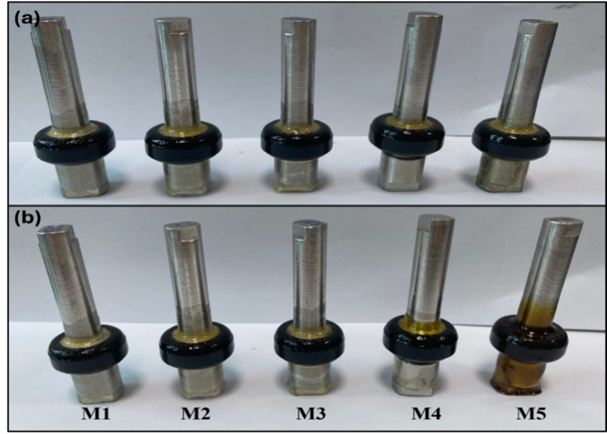
Figure 1. Images of black powder charges coated with adhesive samples M1–M5: (a) before and (b) after six thermal-humidity cycles
In this study, samples M1–M5 were tested for practical use under Vietnam’s humid tropical climate by applying them to black powder charges and subjecting them to six 24-hour thermal-humidity cycles per TCVN 7699-2-30:2007. Figure 1 shows the coated black powder charges before and after testing. The results indicate that samples M1, M2, and M3 maintained their transparency and gloss after six cycles, with no signs of discoloration or surface degradation, as illustrated in Figure 1(b).
Based on prior results, sample M3 (15% modified maleic resin) was chosen to study the effect of alkyd resin content on nitrocellulose adhesive properties. Five variants (M3-1 to M3-5) were prepared with 5–20% alkyd resin and evaluated for appearance, color, viscosity, non-volatile content, acid value, drying time, and fabric-to-wood adhesion. The results for samples M3-1 through M3-5 are summarized in Table 4, alongside the required technical specifications to ensure practical applicability.
Table 4. Table of technical performance results for nitrocellulose adhesive samples M3-1 to M3-5
Technical parameter | M3-1 | M3-2 | M3-3 | M3-4 | M3-5 | Required specifica-tion |
Appearance | Clear, homoge-neous liquid | Clear, homoge-neous liquid | Clear, homoge-neous liquid | Clear, homoge-neous liquid | Clear, homoge-neous liquid | Clear, homoge-neous liquid |
Color (Iodine scale, mg I₂/100 mL) | 800 | 900 | 980 | 1100 | 1180 | ≤ 1400 |
Viscosity (BZ-1 funnel, 20°C, s) | 79 ± 1 | 78 ± 1 | 76 ± 1 | 75 ± 1 | 73 ± 1 | 60–80 |
Non-volatile content (%) | 29.0 ± 0,05 | 29.1 ± 0,05 | 29.2 ± 0,05 | 29.3 ± 0,05 | 29.4 ± 0,05 | 28–31 |
Acid value (mg KOH/g) | 0.25 ± 0,001 | 0.28 ± 0,001 | 0.30 ± 0,001 | 0.32 ± 0,001 | 0.35 ± 0,001 | ≤ 0.5 |
Grade 3 drying time (min) | 24 ± 0,5 | 27 ± 0,5 | 29 ± 0,5 | 32 ± 0,5 | 35 ± 0,5 | ≤ 60 |
Fabric–wood adhesion strength (N/m) | 1360 ± 15 | 1580 ± 15 | 1810 ± 20 | 2050 ± 20 | 2300 ± 20 | ≥ 850 |
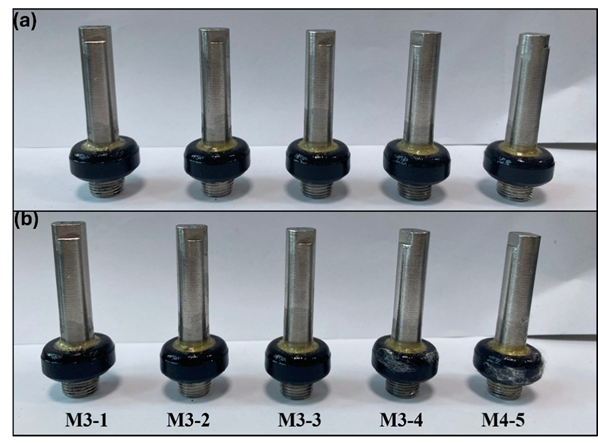
Figure 2. Images of black powder charges coated with adhesive samples M3-1 to M3-5: (a) before and (b) after six thermal-humidity cycles
Continuing the investigation into the influence of modified maleic resin, adhesive samples M3-1 through M3-5 were subjected to cyclic thermal-humidity testing on black powder charges to verify their practical applicability under the tropical monsoon climate typical of Vietnam. The test was conducted in accordance with TCVN 7699-2-30:2007, with each cycle lasting 24 hours and repeated continuously over six cycles. Figure 2 shows images of black powder charges coated with adhesive samples M3-1 to M3-5 before and after six thermal-humidity cycles.
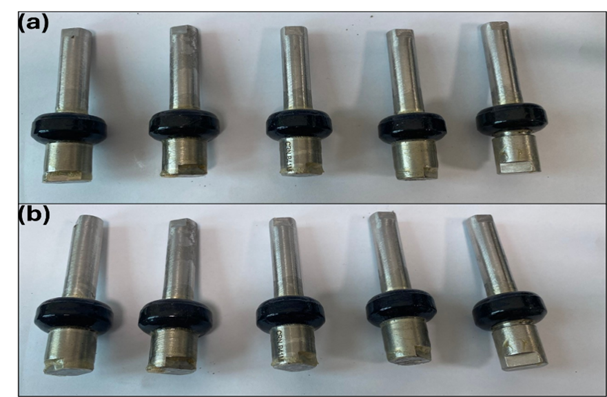
Figure 3. Images of five black powder charges coated with adhesive sample M3-3: (a) before and (b) after 10 thermal-humidity cycles
To further investigate the protective capability of adhesive sample M3-3 under practical conditions, the research team conducted an extended thermal-humidity test over 10 consecutive cycles on five black powder charges. Figure 3 presents the visual comparison of the coated M3-3 samples before and after undergoing 10 thermal-humidity cycles.
Discussion
Effects of modified maleic resin percentage on the properties of the nitrocellulose adhesives
The results listed in Table 3 indicate that the effective dispersion of nitrocellulose within the solvent containing modified maleic resin. The color of all adhesive samples was lighter than the standard threshold on the iodine scale (≤ 1400 mg I₂/100 mL), indicating high purity and no signs of oxidation or impurities that could affect the clarity of the adhesives. Compared with AK20 (1000 mg I₂/100 mL), all M1–M5 samples showed lighter color, confirming higher purity than the industrial reference adhesive. Regarding BZ1 funnel viscosity at 20°C, all samples fell within the acceptable range (60–80 seconds). However, z maleic resin percentage. This reduction in viscosity is attributed to a decrease in hydrogen bonding density due to the reduced nitrocellulose content, resulting in a looser network structure within the adhesive. Additionally, the modified maleic resin, with its flexible molecular structure and weaker intermolecular interactions, contributed to reduced internal friction, making adhesive more fluid.
Sample M1 exhibited the highest viscosity (78 s), suggesting strong film-forming capability but potentially posing challenges in practical application. Sample M2, with a viscosity of 75 seconds, maintained sufficient consistency while beginning to improve flexibility. Sample M4, at 68 seconds, was more favorable for coating and film-forming processes. Sample M5 had the lowest viscosity (65 seconds), offering ease of handling but requiring careful control to ensure film stability after drying. Sample M3, with a moderate viscosity of 72 seconds, demonstrated a balanced profile between consistency and applicability, making it suitable for practical use. In comparison, AK20 showed a viscosity of 71 s, which is lower than M1 and M2 but close to M3. This indicates that M3 most closely matches AK20 in viscosity, while M4 and M5 are more fluid. The non-volatile content of the adhesive samples increased with the percentage of modified maleic resin, ranging from 28.4% (M1) to 30.2% (M5), all within the standard range (28–31%). Sample M2 reached 28.8%, higher than M1, indicating improved film formation. Sample M3 achieved 29.0%, near the midpoint of the acceptable range, supporting stable coating without sedimentation. Sample M4, with 29.6%, continued the upward trend, reflecting a higher solid content; however, exceeding the threshold-as seen in M5 (30.2%)-may affect long-term stability and increase material costs. AK20, with a non-volatile content of 22%, is significantly lower than all M1–M5 samples. This highlights that nitrocellulose adhesives formulated with modified maleic resin provide higher solid content and potentially stronger films compared to AK20. All adhesive samples exhibited very low acid values, ranging from 0.14 to 0.12 mg KOH/g, significantly below the technical limit (≤ 0.5 mg KOH/g). This confirms that the modified maleic resin does not increase the acidity of the adhesives, ensuring chemical stability and safety when applied to sensitive substrates such as wood or fabric. While AK20 showed an acid value of 0.2 mg KOH/g, slightly higher than M1–M5 but still well below the specification limit. This demonstrates that M1–M5 adhesives are chemically more stable than AK20.
Grade 3 drying time decreased markedly from M1 (35 minutes) to M5 (15 minutes). Sample M2 dried in 28 minutes, showing a notable improvement over M1 and enhancing operational efficiency. Sample M3 dried in 22 minutes, offering a balance between fast drying and sufficient working time. Sample M4, with a drying time of 18 minutes, approached the lower limit, which may complicate even spreading or material positioning. Sample M5 dried very quickly (15 minutes), advantageous for rapid production but prone to application errors if not properly controlled. AK20 dried in 36 minutes, slightly slower than M1 and clearly slower than M2–M5, showing the modified resin adhesives dry faster and enhance efficiency.
Notably, the adhesion strength between fabric and wood increased steadily from M1 (910 N/m) to M5 (1690 N/m), with all samples exceeding the technical requirement (≥ 850 N/m). Sample M2 reached 1125 N/m, showing a clear improvement over M1 and enhanced bonding performance. Sample M3 achieved 1340 N/m, continuing the upward trend and reaching an ideal level of mechanical adhesion without requiring excessive resin content. Sample M4 reached 1525 N/m, though its high strength was accompanied by low viscosity and short drying time, which may hinder application. Sample M5 exhibited the highest adhesion strength but also presented limitations in application and increased material cost. AK20 showed 700 N/m wood-fabric adhesion strength, below the requirement and weaker than all M1–M5, confirming the superior bonding of modified resin adhesives. From these results, sample M3 containing 15% modified maleic resin is identified as the optimal formulation. It demonstrates an ideal balance among viscosity, drying time, adhesion strength, and chemical stability, fulfilling both technical specifications and practical adaptability for production and application.
The results and observations in Figure 1 confirm that at modified maleic resin percentages ranging from 10% to 15%, nitrocellulose adhesive films provide effective protection against moisture and temperature fluctuations, while preserving geometric and chemical stability under harsh conditions. Notably, sample M3, containing 15% modified maleic resin, not only met the technical requirements for adhesion strength, drying time, and viscosity. Its ability to retain transparency and gloss after six testing cycles indicates a stable film structure with minimal environmental degradation, making it suitable for use as a protective layer on sensitive materials such as black powder charges during long-term storage or transport through humid regions. In contrast, samples M4 and M5, with higher modified maleic resin percentages (17.5% and 20%), began to show discoloration after thermal-humidity cycling. Sample M4 exhibited a slight yellowing, while M5 showed more pronounced color change, as seen in Figure 1(b). This discoloration is indicative of oxidation or mild degradation within the film structure, suggesting that exceeding the optimal resin threshold may compromise film stability under prolonged exposure to heat and humidity. Such changes directly affect the aesthetic quality, reliability, and protective performance of the coating in practical applications.
Based on these results, it can be concluded that the nitrocellulose adhesive sample containing approximately 15% modified maleic resin (sample M3) is the optimal choice for protecting black powder charges in thermal-humidity environments. In addition to meeting all technical criteria for strength, drying time, and viscosity, the M3 film demonstrated long-term stability, with no changes in color or morphology after testing. These results highlight the potential of this adhesive formulation for defense and military applications involving moisture-sensitive materials.
Effects of alkyd resin percentage on the properties of nitrocellulose adhesive M3
In terms of appearance, all adhesive samples from M3-1 to M3-5 exhibited a clear, homogeneous liquid form without any signs of phase separation or precipitation. This indicates good compatibility between alkyd resin and the nitrocellulose, as well as the overall stability of the adhesive across the entire studied percentage range. The iodine scale color of the samples in Table 4 showed a gradual increase with higher alkyd resin percentages: M3-1 recorded 800 mg I₂/100 mL, M3-2 reached 900 mg I₂/100 mL, M3-3 measured 980 mg I₂/100 mL, M3-4 reached 1100 mg I₂/100 mL, and M3-5 peaked at 1180 mg I₂/100 mL. This increase is reasonable, given the naturally pale yellow hue of alkyd resin, which intensifies the color of the adhesives when added in higher amounts. However, all samples remained within the acceptable limit (≤ 1400 mg I₂/100 mL), ensuring product clarity, particularly important for coatings that must not alter the substrate’s appearance. The BZ-1 funnel viscosity at 20°C showed a slight downward trend as alkyd resin percentage increased, from 79 seconds in M3-1 to 73 seconds in M3-5. This reduction can be attributed to the flexible molecular structure of alkyd resin, which forms weaker interactions with other components in the adhesive. As alkyd content increases, the internal network density, especially with nitrocellulose decreases, leading to reduced internal friction and lower viscosity. Despite this decline, all values remained within the technical specification range (60 - 80 seconds), ensuring effective application, particularly in coating and film-forming processes. The non-volatile content of the adhesive samples also increased slightly with higher alkyd resin percentages: 29.0% in M3-1, 29.1% in M3-2, 29.2% in M3-3, 29.3% in M3-4, and 29.4% in M3-5. This increase directly results from the addition of alkyd resin to the solid phase of the adhesive. These results suggest that alkyd resin not only contributes to the solid content but also plays a significant role in enhancing film durability after drying. As a result, the formed adhesive layer offers improved surface protection, especially under harsh environmental conditions.
The acid value of the samples also showed a gradual increase, from 0.25 mg KOH/g in M3-1 to 0.30 mg KOH/g in M3-3 and 0.35 mg KOH/g in M3-5. This trend is consistent with the chemical nature of alkyd resin, which contains weak acidic functional groups. Nevertheless, all samples remained well within the acceptable limit (≤ 0.5 mg KOH/g), indicating no adverse impact on the chemical stability of the adhesive. Grade 3 drying time increased with higher alkyd resin percentages, from 24 minutes in M3-1 to 35 minutes in M3-5. This extension is primarily due to the slower evaporation rate of alkyd resin compared to nitrocellulose solvents, resulting in a delayed curing process. However, the increase in drying time remains within acceptable limits for practical applications. Furthermore, the adhesion strength between fabric and wood increased significantly with higher alkyd resin percentages: 1360 N/m in M3-1, 1580 N/m in M3-2, 1810 N/m in M3-3, 2050 N/m in M3-4, and 2300 N/m in M3-5–all far exceeding the minimum requirement (≥ 850 N/m). These results highlight the effectiveness of alkyd resin in enhancing the bonding capability of nitrocellulose adhesive. Alkyd resin acts as a film-forming agent and strengthens the interface between different materials, particularly between dissimilar substrates such as fabric and wood. Among the tested samples, M3-3 demonstrated the most optimal balance between technical properties and practical applicability. With 13% alkyd resin, this formulation achieved high film durability, effective moisture resistance, and maintained grade 3 drying time within acceptable limits. The significant improvement in mechanical and physical properties after curing suggests that sample M3-3 is a suitable candidate for practical use under tropical conditions.
Figure 2 clearly illustrates the differences in morphological stability of the adhesive films coated on black powder charges before and after exposure to thermal-humidity stress. Samples M3-1, M3-2, and M3-3 retained their transparency, gloss, and showed no signs of morphological degradation after six cycles, as observed in Figure 2(b). These results indicate that with alkyd resin percentages ranging from 5% to 13%, nitrocellulose adhesive films exhibit strong resistance to high humidity and temperature fluctuations, ensuring effective surface protection in harsh environments. Notably, sample M3-3 reaffirmed its superior performance, not only achieving excellent mechanical properties as previously analyzed, but also maintaining morphological integrity after thermal-humidity testing. This stability suggests that an alkyd resin percentage of 13% is optimal, providing a balanced combination of adhesion strength, drying time, moisture resistance, and chemical stability within the adhesive. In contrast, samples M3-4 and M3-5, when applied to black powder charges and subjected to six thermal-humidity cycles, showed signs of film degradation, including loss of gloss, film sagging, and fiber adhesion, as seen in Figure 2(b). These phenomena indicate structural breakdown of the adhesive film when alkyd resin content exceeds the optimal range. Such deterioration compromises the protective function of the coating under prolonged exposure to heat and humidity, reducing its reliability in real-world applications.
Furthermore, observations after the 10-cycle test revealed that all M3-3 adhesive films maintained their transparency and gloss, with no signs of morphological degradation. There were no occurrences of film sagging, delamination, or loss of adhesion, even under prolonged exposure to fluctuating temperature and humidity. The consistent quality of the adhesive film throughout the extended testing period demonstrates the long-term stability of sample M3-3 in its role as a protective coating for black powder charges.
These results confirm that M3-3 exhibits outstanding resistance, not only meeting technical requirements but also ensuring geometric and chemical stability in harsh environments. In the context of Vietnam’s tropical monsoon climate, characterized by high humidity and frequent temperature variation, this outcome affirms M3-3 as a highly promising adhesive solution for applications demanding long-term durability, moisture resistance, and reliability.
Conclusions
This research investigated the influence of modified maleic resin and alkyd resin percentages on the technical properties of nitrocellulose adhesives. The results confirmed that modified maleic resin plays a pivotal role in improving film performance. Within the tested range of 10% to 20%, a concentration of 15% was identified as optimal, yielding favorable technical parameters: BZ-1 funnel viscosity at 20°C of 72 seconds, non-volatile content of 29.0%, acid value of 0.13 mg KOH/g, grade 3 drying time of 22 minutes, and fabric-wood adhesion strength of 1340 N/m.
Building on this formulation, the research further explored the effect of alkyd resin within the range of 5% to 20%. A concentration of 13% alkyd resin demonstrated significant enhancements in film characteristics, including viscosity of 76 seconds, non-volatile content of 29.2%, acid value of 0.30 mg KOH/g, grade 3 drying time of 29 minutes, and fabric-wood adhesion strength reaching 1810 N/m.
The adhesive samples were applied to black powder charges and tested under cyclic thermal-humidity conditions to assess durability in harsh environments. Among all formulations, sample adhesive M3-3 with 15% modified maleic resin and 13% alkyd resin-showed outstanding performance. After 10 cycles, the film remained transparent, glossy, and intact, with no signs of cracking or delamination. These results confirm its strong resistance to moisture and temperature fluctuations, making it a promising candidate for protective use in Vietnam’s tropical monsoon climate.
Acknowledgments: This work was supported by the Joint Vietnam-Russia Tropical Science and Technology Research Center (Grant No. ĐB.N1.24/24).
Data Availability Statement: All relevant data supporting the findings of this study are included within the article and its supplementary materials.
Author Contributions: Luu Van Tuynh: Conceptualization, Methodology, Writing – Original Draft; Phan Van Truong: Sample Preparation, Investigation; Phan Van Truong, Nguyen Van Thanh: Writing – Review & Editing.
Conflict of Interest Statement: The authors declare no conflict of interest.
Statement on the Use of Generative AI (GenAI): The authors declare that AI tools were used only for language editing/formatting, and not for generating scientific content. All data, analyses, and interpretations were performed and verified by the authors, who take full responsibility for the manuscript.
References
da Silva, L. F. M., Öchsner, A., & Adams, R. D. (Eds.). (2018). Handbook of adhesion technology (2nd ed.). Springer International Publishing. https://doi.org/10.1007/978-3-319-55411-2
Elliott, W. T. (1993). Alkyd resins. In Surface coatings: Volume 1. Raw materials and their usage (pp. 76–109). Springer Netherlands. https://doi.org/10.1007/978-94-011-1220-8_5
GOST 17537-72. (1972). Paint and varnish materials–Methods for determining mass fraction of volatile/non-volatile substances, solids, and film-forming substances.
GOST 19007-73. (1973). Paint and varnish materials–Method for determining drying time and degree of drying.
GOST 19266-73. (1973). Paint and varnish materials–Method for determining color using the iodometric scale.
GOST 23955-80. (1980). Paint and varnish materials–Methods for determining acid number.
GOST 8420-74. (1974). Paint and varnish materials–Methods for determining conditional viscosity.
Ifijen, I. H., Maliki, M., Odiachi, I. J., Aghedo, O. N., & Ohiocheoya, E. B. (2022). Review on solvent-based alkyd resins and water-borne alkyd resins: Impacts of modification on their coating properties. Chemistry Africa, 5, 211–225. https://doi.org/10.1007/s42250-022-00318-3
John, J., Archana, K. S., Thomas, A. M., Thomas, R. L., Thomas, J., Thomas, V., & Unnikrishnan, N. V. (2024). Nitrocellulose unveiled: A brief exploration of recent research progress. Sustainable Chemical Engineering, 5, 146–167. https://doi.org/10.37256/sce.5120243950
Morris, E., Pulham, C. R., & Morrison, C. A. (2023). Structure and properties of nitrocellulose: Approaching 200 years of research. RSC Advances, 13, 32321–32333. https://doi.org/10.1039/D3RA05457H
Pu, C., Meng, X., Luan, Y., Jiang, Z., & Xiao, Z. (2025). Mechanism and influence factors of mechanical sensitivity of nitrocellulose. Cellulose, 32, 5903–5915. https://doi.org/10.1007/s10570-025-06597-6
Sasse, R. A. (1981). The influence of physical properties on black powder combustion. U.S. Army Ballistic Research Laboratory. https://apps.dtic.mil/sti/tr/pdf/ADA100273.pdf
Sawant, M. (2023). Weather—The only constant in warfare. Marine Corps University Press. https://doi.org/10.36304/ExpwMCUP.2023.01
TU 6-10-1293-78. (1978). Nitro adhesive AK-20: Technical specifications.
Zhang, J. (Ed.). (2012). Rosin-based chemicals and polymers. Smithers Rapra.
Zhang, X., Zhou, Y., Li, Z., Zhu, J., Ren, J., Duan, X., Shen, J., Duan, X., & Pei, C. (2025). High-performance, formaldehyde-free, multi-functional nitrocellulose adhesive in various environments. Chemical Engineering Journal, 511, Article 162064. https://doi.org/10.1016/j.cej.2025.162064