

Article Sidebar

 CC BY 4.0
Open access
CC BY 4.0
Open access
You may copy, redistribute and adapt this article, provided that you:
-
Credit the authors and the original article
© 2026 Journal of Tropical Science and Engineering
Formulation of Freeze-Dried Microbial Preparations from Selected Bacterial Strains for the Treatment of Oil Pollution in Aquatic Environments
Main Article Content
Abstract
The effective implementation of bioremediation is often constrained by the stability and delivery of microbial inocula. This study investigated the development and optimization of a hydrocarbon-degrading consortium comprising three indigenous bacterial strains: Rhodococcus ruber JN5.2, Stenotrophomonas acidaminiphila ZB2.1, and Bacillus amyloliquefaciens MD3.3. Phylogenetic analysis confirmed the taxonomic diversity of the members, while cross-streak assays established total biological compatibility, enabling stable coexistence. In synthetic wastewater containing 5% (v/v) oil, the bacterial consortium achieved a total petroleum hydrocarbon (TPH) removal efficiency of 78 ± 6% within 14 days. This performance significantly exceeded that of individual strains (51-54%), supported by a Synergy Index (SI) of 1.48 and a peak biomass density of 8.6 ± 0.9 × 10⁸ CFU/mL. To enhance practical applicability, freeze-drying conditions were optimized. Harvesting biomass at the 24-hour growth phase and utilizing a protective formulation of 10% skim milk, 5% sodium glutamate, and 20% bentonite preserved bacterial viability at ≥ 9.3 log₁₀ CFU/mL after one month of storage. The consortium was evaluated in three formulations: liquid culture, freeze-dried powder (FDO-VN25), and alginate-immobilized beads. Validation using real car-washing wastewater (TPH ≤ 100 mg/L) revealed that while all the formulations improved degradation, the alginate-immobilized system consistently exhibited the highest stability and efficacy, achieving over 60% TPH removal after 14 days. These results demonstrate that integrating a native multi-species consortium with optimized lyophilization and alginate encapsulation provides a robust microbial solution for treating low-strength petroleum-contaminated effluents in complex environments.
Keywords
Bioremediation, Freeze-drying, Microbial consortium, Oil biodegradation, Wastewater treatment
Article Details
Introduction
Oil-contaminated water and wastewater generated by petroleum-related activities and routine urban operations (e.g., vehicle washing) remain a significant environmental concern. Petroleum hydrocarbons can persist in aquatic environments and pose ecological and human- health risks, motivating the development of efficient and environmentally compatible treatment strategies. Microbial bioremediation remains a preferred approach due to its ability to mineralize hydrocarbons into non-toxic end products; however, its practical implementation is often limited by the metabolic constraints of individual strains and the environmental sensitivity of the used inocula (Bellali et al., 2020; Mansour et al., 2024).
In practical applications, the field performance of bioremediation is determined not only by the degradation potential of the selected microorganisms but also by their formulation, storage stability, and delivery methods. Conventional liquid inocula often have a short shelf-life and significant viability loss during transport, which limits large-scale deployment (Bellali et al., 2020). While freeze-drying (lyophilization) is widely utilized to improve microbial stability, the functional recovery of hydrocarbon-degraders depends heavily on optimized process conditions and protective formulations. Recent studies have emphasized the need for ready-to-use microbial products, yet research into multi-strain freeze-dried consortia specifically tailored for low-strength wastewater remains in its infancy (Chen et al., 2025; Do et al., 2022; Li et al., 2021).
A critical research gap exists in the development of delivery-oriented microbial products for decentralized treatment. Current literature predominantly focuses on physico-chemical treatments or engineered reactor-based systems (e.g., membrane bioreactors) for oily wastewater (Do et al., 2018). Furthermore, most bioremediation studies use synthetic media spiked with artificial oil, which fails to account for the complex organic matrices and low-strength hydrocarbon loading (TPH ≤ 100 mg/L) characteristic of real-world vehicle-washing effluents. Direct comparisons of liquid cultures, freeze-dried powders, and immobilized microbial systems under realistic, non-spiked conditions are still limited (L. Chen et al., 2019; W. Chen et al., 2025).
The novelty of this study lies in the strategic integration of three distinct elements: the design of a native multi-strain consortium (R. ruber JN5.2, S. acidaminiphila ZB2.1, and B. amyloliquefaciens MD3.3), the optimization of a bentonite-enhanced lyophilization process, and the application of alginate immobilization for enhanced field efficiency. To our knowledge, only a few studies have integrated these elements, including native consortium design, optimized freeze-drying, and alginate immobilization, and validated performance in lightly contaminated real wastewater without artificial oil spiking (Pal et al., 2024). By comparing the performance of liquid, freeze-dried, and immobilized formulations, this research provides an application-oriented, research-based framework for developing stable microbial products to treat heterogeneous urban wastewater streams.
Materials and Methods
Research Materials
Three indigenous hydrocarbon-degrading bacterial strains were used in this study, including Stenotrophomonas acidaminiphila ZB2.1, Rhodococcus ruber JN5.2, and Bacillus amyloliquefaciens MD3.3. These strains were isolated from oil-contaminated sludge and wastewater samples collected from vehicle- washing sites in Hanoi, Thanh Hoa and Dong Nai, Vietnam, and identified via 16S rRNA gene sequencing (GenBank accession numbers PQ351238, PQ351241, and PV550465, respectively) (Figure 1). The strains were maintained on nutrient agar slants at 4 °C and periodically subcultured at the Microbiology Laboratory, Joint Vietnam–Russia Tropical Science and Technology Research Center.
For inoculum preparation, each strain was cultivated individually in mineral salts medium (MSM) supplemented with 1% (v/v) oil as the sole carbon source and incubated at 30 °C with shaking at 150 rpm until reaching the late exponential growth phase. Cell suspensions were harvested and adjusted to an initial density of approximately 1.0 × 10⁸ CFU/mL prior to experimental use.
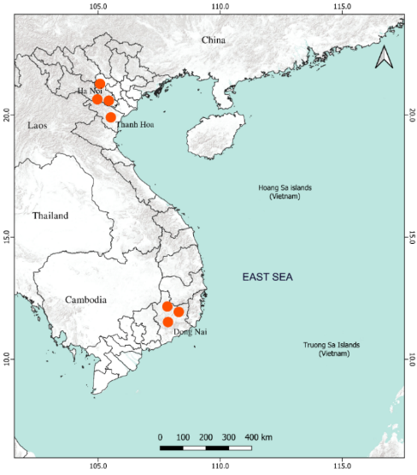
Figure 1. Geographic locations of the sampling sites for oil-contaminated sludge and wastewater in Hanoi, Thanh Hoa, and Dong Nai, Vietnam
Research Methodology
Assessment of Inter-Strain Compatibility
Inter-strain compatibility was evaluated using cross-streak assays on MSM agar plates supplemented with 1% (v/v) oil. Each strain was streaked perpendicular to the others and incubated at 30 °C for 72 h. The presence or absence of inhibition zones at the intersection areas was recorded to assess potential antagonistic interactions among the strains.
Molecular Identification and Combined Phylogenetic Analysis
Bacterial strains were identified by 16S rRNA gene sequencing, and the sequences were deposited in GenBank under the accession numbers JN5.2 (PQ351241), ZB2.1 (PQ351238), and MD3.3 (PV550465). To visualize the phylogenetic placement and taxonomic distance among the three selected strains of the consortium, a combined phylogenetic tree was reconstructed in MEGA X using the Neighbor-Joining method together with closely related reference sequences retrieved from GenBank. Node support was assessed by bootstrap resampling with 1,000 replicates. Methanosarcina barkeri (M591441) was used as an outgroup.
Experimental Design for Oil Biodegradation
Biodegradation experiments were conducted in 250 mL Erlenmeyer flasks containing 100 mL of MSM supplemented with 5% (v/v) oil as the sole carbon and energy source under controlled synthetic conditions. The experimental treatments included: C1: S. acidaminiphila ZB2.1, C2: R. ruber JN5.2, C3: B. amyloliquefaciens MD3.3, C4: Consortium of ZB2.1 + JN5.2 + MD3.3 (in equal proportions), and Control: MSM without microbial inoculation. Each treatment was inoculated to obtain an initial cell density of 1.0 × 10⁸ CFU/mL. All flasks were incubated at 30 °C under shaking conditions (150 rpm) for 14 days. Experiments were performed in triplicate. Pairwise combinations of strains were not examined in this study, as the experimental design primarily aimed to compare individual strains with the fully integrated three-member consortium to assess overall synergistic performance.
Samples were collected at 0, 7, and 14 days of incubation. Residual oil concentration was determined gravimetrically after solvent extraction, and biodegradation efficiency was calculated as the percentage of oil removed relative to the initial concentration. Viable cell counts were determined by the plate count method on nutrient agar and expressed as CFU/mL.
An uninoculated control (MSM plus oil without microbial inoculation) was included to account for non-biological losses during incubation. Under the applied shaking and incubation conditions, such losses may include limited hydrocarbon volatilization and passive adsorption to flask surfaces. Because no additional abiotic adsorption controls were included, the microbial contribution was interpreted relative to the uninoculated control.
Evaluation of Synergistic Interaction
The synergistic effect of the microbial consortium was assessed using the Synergy Index (SI), calculated as (1) (Kim et al., 2019):
Where Ec is the oil biodegradation efficiency of the consortium (C4) achieved by the consortium at day 14, and E1, E2, and E3 are the efficiencies of the individual strains tested under identical conditions at day 14. Because the consortium was prepared by mixing the three bacterial strains at equal inoculum proportions (1:1:1), the expected additive effect was defined as the arithmetic mean of the efficiencies of the three individual strains. SI values were interpreted as synergism (SI > 1), additive effect (SI ≈ 1), or antagonism (SI < 1).
Because pairwise combination experiments were not included in the present design, the SI should be interpreted as a screening-level indicator of apparent functional synergy based on biodegradation output, rather than as definitive proof of specific biological interactions among consortium members.
Freeze-Drying Procedure and Stability Assessment
Bacterial biomass was harvested by centrifugation at 4,000 rpm for 15 min, and the supernatant was discarded. The cell pellet was resuspended in an equal volume of protective solution. Aliquots were transferred into sterile freeze-drying vials, frozen at -80 °C for 4 h, and subsequently freeze-dried at -47 °C under a vacuum pressure below 0.001 mbar for 24 h using a laboratory-scale lyophilizer.
The effects of cultivation time before to freeze-drying, protective formulations, and bentonite supplementation ratios were systematically evaluated. Viable cell densities were determined before freeze-drying, 48 h after freeze-drying, and after one month of storage under different temperature conditions.
Quality control of freeze-dried products was performed by evaluating physical appearance, residual moisture content, microbial viability (CFU/g), absense of contamination, and stability during storage, in accordance with relevant international and national standards.
Evaluation of Oil Biodegradation Performance of Different Formulations
The microbial consortium was evaluated in three formulations: liquid culture, freeze-dried powder, and alginate-immobilized gel beads. Oil biodegradation experiments were conducted under the same conditions described in Section 2.2.3. Microbial cell density and oil removal efficiency were monitored over a 14-day incubation period, with sampling at 0, 7, and 14 days.
Alginate Immobilization of Freeze-Dried Consortium (Gel Beads)
Alginate-immobilized microbial beads were prepared by encapsulating the freeze-dried consortium in sodium alginate and then ionic gelation with calcium chloride. Briefly, a sterile sodium alginate solution (5%, w/v) was prepared and homogenized. The freeze-dried microbial formulation was then added to the alginate solution at 2% (w/v; i.e., 2 g of freeze-dried product per 100 mL of alginate solution) and mixed thoroughly to obtain a uniform suspension. Separately, a sterile CaCl₂ solution (1%, w/v) was prepared and used as the gelling bath.
The alginate-microbe suspension and the CaCl2 gelling bath were installed in an encapsulation setup. The flow rate of the alginate suspension was adjusted to 100 mL/min. The distance between the outlet of the encapsulation device and the surface of the CaCl2 bath was optimized to prevent bead breakage upon contact and to obtain spherical beads. During bead formation, the CaCl2 solution was gently stirred using a magnetic stirrer to promote uniform bead rounding. After processing approximately half of the alginate suspension volume, the CaCl2 gelling solution was replaced with fresh 1% CaCl2 to maintain consistent gelation conditions. The formed beads were left in the CaCl2 bath for 30 min to stabilize/harden, then recovered under aseptic conditions.
The viable cell concentration in the immobilized beads was > 10⁸ CFU/g (wet beads). The beads were visually uniform and spherical and stored in sterile distilled water until use.
Biodegradation Experiments in Lightly Oil-Contaminated Real Wastewater
Real wastewater was collected from routine vehicle washing.
This wastewater was considered a representative low-strength oily wastewater matrix containing not only petroleum hydrocarbons but also biodegradable organic matter and likely detergent-/surfactant-related compounds from washing operations. Before inoculation, the wastewater was characterized by low petroleum hydrocarbon concentrations (approximately 100 mg/L TPH) together with measurable organic load, as reflected by COD and BOD. Because the wastewater originated from routine vehicle washing, detergent- and surfactant-related compounds were considered qualitatively likely, although surfactants were not quantified separately in the present study. No oil spiking or nutrient supplementation was applied before to the experiments.
Biodegradation experiments were conducted in 500 mL Erlenmeyer flasks containing 300 mL of the real wastewater. Four experimental treatments were established: (i) RW-C (uninoculated control), (ii) RW-L (liquid microbial consortium), (iii) RW-FD (freeze-dried microbial preparation FDO-VN25), and (iv) RW-IM (alginate-immobilized microbial consortium). For inoculated treatments, the initial microbial dosage was adjusted to obtain comparable viable cell densities among formulations.
All flasks were incubated at 28-30 °C under gentle mixing conditions (approximately 60 rpm) to ensure adequate oxygen transfer while minimizing hydrocarbon volatilization. Experiments were conducted for 14 days. Samples were collected at 0, 7, and 14 days for analysis.
TPH concentrations were determined by solvent extraction followed by gravimetric analysis, while COD was measured using standard dichromate methods. Microbial biomass was quantified by viable cell counting using the plate count method and expressed as CFU/mL for CFU/mL for the aqueous phase of the liquid and reconstituted freeze-dried treatments, and as CFU/g (wet beads), and as CFU/g for alginate-immobilized beads. All experiments were performed in triplicate.
An uninoculated wastewater control (RW-C) was included to estimate non-biological decreases in TPH during incubation. Such decreases may reflect limited volatilization of lighter hydrocarbon fractions and passive adsorption to flask surfaces or wastewater solids. In the immobilized treatment, some contribution from physical retention or adsorption onto alginate beads and bentonite-containing carriers cannot be fully excluded.
Analytical Methods - Total Petroleum Hydrocarbons (TPH) by Gravimetry
TPH concentrations in synthetic and real wastewater samples were quantified by solvent extraction followed by gravimetric determination. For lightly contaminated wastewater (≤100 mg/L TPH), relatively large sample volumes (typically 500-1000 mL, up to 1 L when necessary) were used to improve gravimetric sensitivity. In contrast, smaller volumes were used for more heavily contaminated samples. A known volume of well-mixed sample was transferred into a separatory funnel, sodium chloride was added to promote phase separation, and the sample pH was adjusted to approximately neutral (pH ≈ 7) when necessary.
TPH was extracted by liquid–liquid extraction with n-hexane in three consecutive portions, with vigorous shaking and periodic venting of the separatory funnel to release pressure. The combined organic extracts were passed through anhydrous sodium sulfate (Na₂SO₄) to remove residual water and then concentrated by gentle evaporation to near dryness.
Gravimetric determination was carried out using pre-cleaned, pre-weighed glass weighing dishes. The concentrated extract was quantitatively transferred into the weighing dish, the solvent was allowed to evaporate to constant mass under controlled conditions (ambient temperature or ≤ 40 °C, avoiding splashing), and the dish was cooled in a desiccator before weighing. TPH concentration (mg/L) was calculated from the net residue mass (sample residue minus method blank residue) divided by the extracted sample volume. Removal efficiency (%) was calculated from initial and final TPH concentrations as (2):
where:
C0 is the initial TPH concentration in the wastewater (mg/L).
Ct is the final TPH concentration at the end of the treatment period (mg/L).
Quality control included at least one method blank processed with each extraction batch and duplicate extractions for selected samples. All TPH results were blank-corrected before reporting. All glassware was thoroughly solvent-rinsed to minimize background contamination. The gravimetric TPH method used in this study had a reported LOD of 1.5 mg/L; however, because formal LOQ and recovery values were not established, the data, particularly for lightly contaminated real wastewater, should be interpreted primarily as comparative indicators of petroleum-related extractable residue.
Statistical Analysis
All experiments were conducted in triplicate (n=3), and results are expressed as mean ± standard deviation (SD). Statistical analyses were performed in R (version 4.3.2). For comparisons among multiple treatments at a given time point, one-way ANOVA was used after checking model assumptions using residual diagnostics. When significant differences were detected (p < 0.05), Tukey’s HSD post hoc test was applied for pairwise comparisons. Graphs were generated in R (ggplot2).
Results
Biological Compatibility and Oil Biodegradation Performance of the Selected Bacterial Strains
Assessment of Inter-Strain Compatibility
Cross-streak assays revealed that S. acidaminiphila ZB2.1, R. ruber JN5.2, and B. amyloliquefaciens MD3.3 did not produce any visible inhibition zones after 72 h of incubation on oil-supplemented MSM agar. All strains exhibited stable growth at the intersection areas, indicating the absence of antagonistic interactions. These results confirm that the three strains are biologically compatible and capable of coexisting in a mixed culture, thereby fulfilling a fundamental requirement for constructing a stable microbial consortium for oil biodegradation.
Phylogenetic Placement of the Selected Consortium Members
The combined 16S rRNA gene phylogeny confirmed that the three selected strains belong to phylogenetically distant lineages, namely R. ruber JN5.2, S. acidaminiphila ZB2.1, and B. amyloliquefaciens MD3.3 (Figure 2). The wide taxonomic distance among these strains supports the rationale for constructing a multi-genus consortium to integrate complementary traits relevant to hydrocarbon biodegradation.
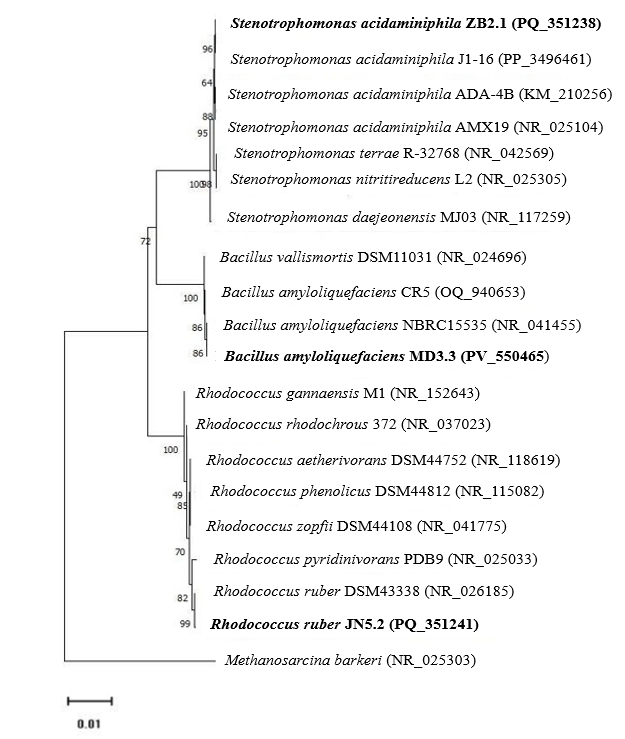
Figure 2. Neighbor-Joining phylogenetic tree based on 16S rRNA gene sequences showing the placement of JN5.2, ZB2.1, and MD3.3 relative to selected reference sequences retrieved from GenBank. Bootstrap support values (%) were calculated from 1,000 replicates and are shown at the nodes. Methanosarcina barkeri (M591441) was used as an outgroup
Oil Biodegradation Efficiency of Individual Bacterial Strains and the Consortium
Oil biodegradation efficiencies of the individual strains and the bacterial consortium are presented in Table 1. At all sampling times, treatments inoculated with microorganisms exhibited significantly higher oil removal efficiencies than the uninoculated control.
Among the individual strains, R. ruber JN5.2 showed the highest biodegradation efficiency, reaching 54±5% after 14 days, followed by S. acidaminiphila ZB2.1 (51±4%) and B. amyloliquefaciens MD3.3 (53±3%). Although differences among the single strains were relatively small, their biodegradation efficiencies were markedly lower than that of the microbial consortium.
The consortium (C4) achieved an oil removal efficiency of 56 ± 5% after 7 days, increasing to 78±6% after 14 days. These values exceeded those of all single-strain treatments at the corresponding time points, supporting the superior performance of the mixed culture.
Table 1. Oil biodegradation efficiency of individual bacterial strains and the microbial consortium under synthetic wastewater conditions
Treatment | Oil biodegradation (%) - Day 7 | Oil biodegradation (%) - Day 14 |
C1 – S. acidaminiphila ZB2.1 | 35 ± 3 | 51 ± 4 |
C2 – R. ruber JN5.2 | 37 ± 4 | 54 ± 5 |
C3 – B. amyloliquefaciens MD3.3 | 28 ± 2 | 53 ± 3 |
C4 – Consortium | 56 ± 5 | 78 ± 6 |
Control | 6 ± 1 | 9 ± 2 |
Biomass Development and Evaluation of Synergistic Interaction
Viable cell counts measured at day 14 revealed pronounced differences in biomass development among the treatments (Table 2). The microbial consortium exhibited the highest cell density, reaching (8.6 ± 0.9) × 10⁸ CFU/mL, which was approximately 1.9–3.1 times higher than that observed for the individual strains.
Based on the average oil biodegradation efficiencies of the individual strains (52.67%) and the consortium (78.0%), the calculated SI was approximately 1.48. An SI value greater than 1 clearly indicates an apparent synergy among the consortium members, rather than a simple additive effect (Kim et al., 2019). Because pairwise combination experiments were not conducted, the synergy index should be interpreted as a screening indicator rather than a definitive measure of all possible interactions. Future studies examining pairwise combinations under different conditions are needed to confirm specific interactions among consortium members. It should be noted that the synergy index depends on the definition of 'additive expectation.' In this study, the additive expectation was defined based on a 1:1:1 mixing ratio and the calculation method described above. Therefore, the SI is model-dependent and should be interpreted as an indicator of synergistic tendency rather than mechanistic proof of specific interactions.
Based on biological compatibility, biodegradation efficiency, and biomass development, the consortium comprising S. acidaminiphila ZB2.1, R. ruber JN5.2, and B. amyloliquefaciens MD3.3 was selected for subsequent formulation and stabilization studies.
Table 2. Biomass development of individual bacterial strains and the microbial consortium under synthetic wastewater conditions
Treatment | Cell density (CFU/mL, Day 14) |
C1 - ZB2.1 | (3.1 ± 0.4) × 10⁸ |
C2 - JN5.2 | (4.5 ± 0.6) × 10⁸ |
C3 - MD3.3 | (2.8 ± 0.3) × 10⁸ |
C4 - Consortium | (8.6 ± 0.9) × 10⁸ |
Control | (7.1 ± 0.7) × 10³ |
Optimization of Freeze-Drying Conditions to Enhance Microbial Stability
Effect of Biomass Harvesting Time on Post-Freeze-Drying Survival
The influence of biomass harvesting time on post–freeze-drying survival was evaluated at 16 h, 24 h, and 32 h (Figure 3). The results demonstrated that harvesting time had a pronounced effect on the survival of all three bacterial strains.
Biomass harvested at 16 h exhibited relatively low initial cell densities and suffered substantial viability loss after freeze-drying, with viable cell densities after one month of storage reaching only approximately 8.1–8.4 log₁₀ CFU/mL. Although biomass harvested at 32 h showed higher initial cell densities, it exhibited a greater decline in viability during storage than biomass harvested at 24 h.
Compared with other harvest times, biomass harvested at 24 h consistently showed the highest post–freeze-drying survival, maintaining viable cell densities above 9.5 log₁₀ CFU/mL after one month of storage. These results indicate that harvesting cells at the optimal growth phase provides the most favorable balance between initial biomass yield and freeze-drying tolerance.
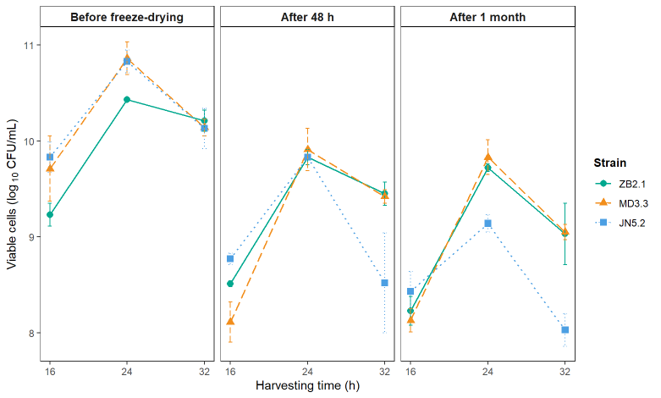
Figure 3. Effect of harvesting time on the viable cell counts (log₁₀ CFU/mL) of strains ZB2.1, MD3.3 and JN5.2 before freeze-drying, after 48 h and after 1 month of freeze-dried storage.
Data are presented as mean ± SD (n = 3)
Effect of Protective Agents on Microbial Stability After Freeze-Drying
Three different protective formulations were evaluated for their ability to preserve cell viability during freeze-drying. Regardless of the formulation applied, a reduction in viable cell density was observed after freeze-drying, reflecting the unavoidable stress associated with the process.
However, the extent of viability loss varied markedly among the formulations. Protective formulations containing skim milk in combination with sodium glutamate (CT2 and CT3) consistently resulted in higher viable cell densities than the formulation containing skim milk alone (CT1). Among them, CT2 (10% skim milk and 5% sodium glutamate) exhibited the most stable and reproducible performance across all three strains, maintaining viable cell densities ranging from 9.01 to 9.65 log₁₀ CFU/mL after one month of storage (Figure 4). As no substantial improvement was observed upon adding trehalose, CT2 was selected as the optimal protective formulation for subsequent experiments.
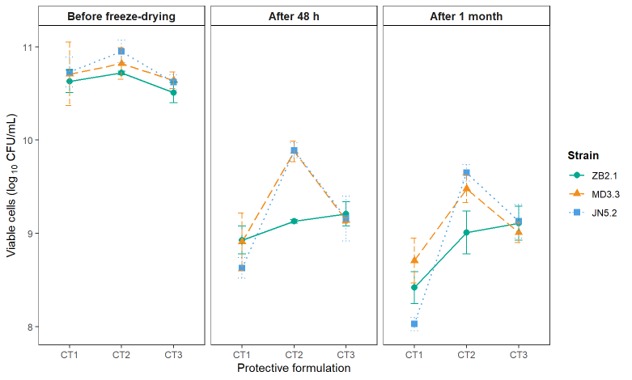
Figure 4. Effect of different protective formulations on the viability of bacterial strains before and after freeze-drying. Viable cell counts (log10 CFU/mL) of strains ZB2.1, MD3.3 and JN5.2 were determined (A) before freeze-drying, (B) after 48 h of storage and (C) after 1 month of storage. Data are presented as mean ± SD (n = 3)
Influence of Bentonite on the Stability of Freeze-Dried Formulations
The effect of bentonite supplementation on freeze-dried microbial stability was evaluated at concentrations ranging from 10% to 25% (Figure 5). The results showed that bentonite supplementation did not adversely affect microbial survival during freeze-drying or subsequent storage.
Across all strains, bentonite at 20% concentration yielded in the highest viable cell density after 1 month of storage (>9.3 log₁₀ CFU/mL). Increasing the bentonite concentration beyond 20% did not lead to further improvements, suggesting a saturation effect. These findings indicate that bentonite can be effectively incorporated into freeze-dried formulations to enhance product stability without compromising microbial viability.
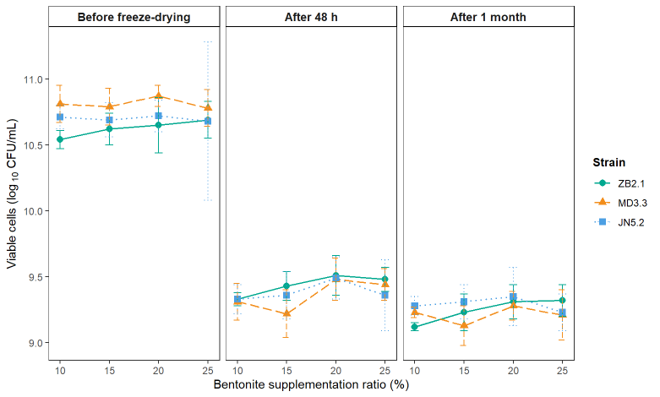
Figure 5. Effect of bentonite supplementation ratio on the viability of bacterial strains after freeze-drying. Viable cell counts (log10 CFU/mL) of strains ZB2.1, MD3.3 and JN5.2 were measured at different bentonite supplementation levels (10–25%) (A) before freeze-drying, (B) after 48 h of storage and (C) after 1 month of storage. Data are presented as mean ± SD (n = 3)
Selection of the Optimal Freeze-Dried Formulation
Based on post–freeze-drying viability, storage stability, and formulation feasibility, the optimal freeze-dried formulation for all three strains consisted of 10% skim milk, 5% sodium glutamate, and 20% bentonite. This formulation was therefore selected for the production of the freeze-dried microbial preparation FDO-VN25, which was used in subsequent biodegradation experiments.
Baseline Oil Biodegradation Performance Under Synthetic Wastewater Conditions
Microbial Population Dynamics During Oil Biodegradation
Distinct differences in microbial population dynamics were observed among the tested formulations (Figure 6). In the uninoculated control, bacterial cell density remained negligible and oil removal was minimal throughout the 14-day experimental period. In the liquid formulation (TN1), bacterial cell density increased from 8.10 ± 0.05 log₁₀ CFU/mL at day 0 to 8.80 ± 0.10 at day 7 and 9.20 ± 0.09 at day 14. The freeze-dried formulation (TN2) showed a similar growth trend, increasing from 8.05 ± 0.04 log₁₀ CFU/mL at day 0 to 8.50 ± 0.12 at day 7 and 9.00 ± 0.11 at day 14.
The alginate-immobilized formulation (TN3) maintained the highest bacterial cell densities throughout the monitoring period, increasing from 8.12 ± 0.03 log₁₀ CFU/mL on day 0 to 8.65 ± 0.08 on day 7 and to 9.40 ± 0.07 on day 14. The surface morphology and bacterial distribution within the alginate gel beads were characterized using scanning electron microscopy (SEM) (Figure 7).
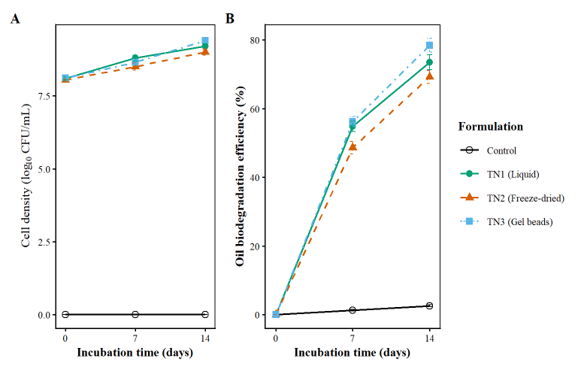
Figure 6. Changes in (A) microbial cell density (log₁₀ CFU/mL) and (B) oil biodegradation efficiency of different microbial formulations under synthetic wastewater conditions. Control, TN1 (liquid culture), TN2 (freeze-dried powder), and TN3 (gel beads) were monitored over 14 days of incubation (0, 7, and 14 days). Data are presented as mean ± SD (n = 3)
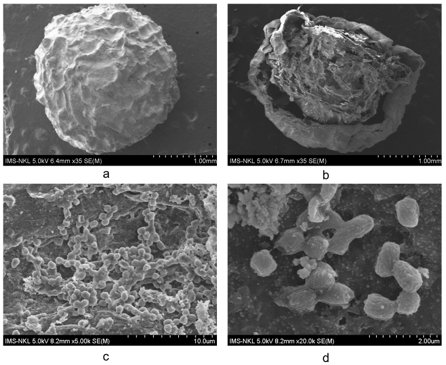
Figure 7. SEM images of gel beads: (a) external surface; (b) internal structure after breaking the outer layer; (c–d) immobilized bacteria on gel bead surface
Comparison of Oil Biodegradation Efficiency Among Different Formulations
Oil biodegradation efficiency increased progressively over time in all inoculated treatments (Figure 6). By day 7, oil removal efficiencies reached 54.8 ± 1.5% (TN1), 48.6 ± 1.8% (TN2), and 56.2 ± 1.4% (TN3), whereas the uninoculated control showed only 1.3 ± 0.2% removal.
On day 14, the liquid and freeze-dried formulations achieved oil removal efficiencies of 73.5 ± 2.2% and 69.2 ± 1.9%, respectively, indicating that freeze-drying did not substantially compromise the intrinsic biodegradation activity of the bacterial consortium. The highest oil removal efficiency was observed in the alginate-immobilized formulation (TN3), achieving 78.4 ± 2.0% on day 14. The results indicate that the freeze-dried microbial preparation FDO-VN25 retained strong oil-degrading activity over 14 days, and that alginate immobilization further improved microbial stability and biodegradation efficiency under synthetic wastewater conditions. Alginate beads (TN3) achieved 78.4% TPH removal, compared with 73.5% (liquid) and 69.2% (freeze-dried), due to enhanced biomass retention. Similar to Khandelwal et al. (2022), immobilization boosted TPH removal > 70% and reusability in real wastewater.
Biodegradation Performance in Lightly Oil-Contaminated Real Wastewater From Routine Vehicle Washing
Removal of Petroleum Hydrocarbons and Organic Matter
The studied wastewater is a typical low-strength, oil-contaminated effluent commonly generated in tropical urban environments, where routine vehicle washing is a widespread and centralized wastewater treatment is often unavailable. The biodegradation performance of the microbial formulations was evaluated using real wastewater characterized by low oil loading and a complex organic matrix typical of routine vehicle washing effluents. Changes in TPH concentrations during the experimental period are presented in Figure 8.
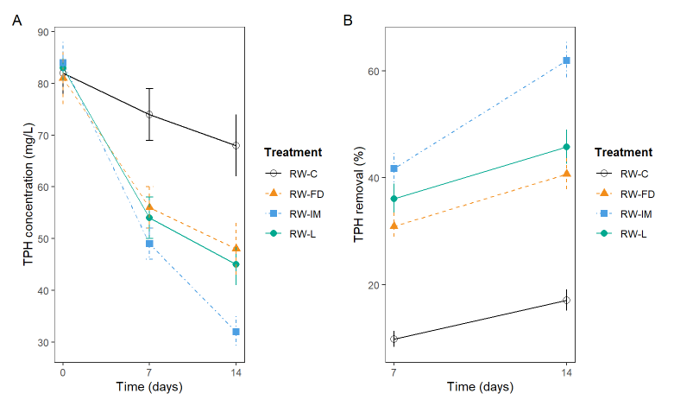
Figure 8. Changes in (A) total petroleum hydrocarbon (TPH) concentration and (B) TPH removal efficiency in lightly oil-contaminated real wastewater from routine vehicle washing activities treated with different microbial formulations (RW-C, RW-L, RW-FD, and RW-IM). Data are presented as mean ± SD (n = 3)
In the uninoculated control (RW-C), only limited reductions in TPH and COD were observed throughout the experimental period, with approximately 15% TPH removal after 14 days. This indicates that natural attenuation processes such as volatilization and adsorption contributed only marginally to hydrocarbon removal under the applied experimental conditions.
Compared with the uninoculated control, all microbial formulations significantly enhanced hydrocarbon removal. After 14 days, the liquid formulation (RW-L) and the freeze-dried formulation (RW-FD) achieved TPH removal efficiencies of approximately 45% and 40%, respectively. The alginate-immobilized formulation (RW-IM) consistently exhibited the highest performance, reaching over 60% TPH removal. A similar trend was observed for COD reduction, confirming that the microbial consortium contributed to the degradation of both petroleum hydrocarbons and other biodegradable organic compounds present in the wastewater.
These results demonstrate that the proposed microbial formulations remain effective under low oil loading and complex organic conditions representative of lightly oil-contaminated real wastewater.
Biomass Retention and Microbial Stability
Distinct differences in biomass stability were observed among the tested formulations. Viable cell densities in the liquid (RW-L) and freeze-dried (RW-FD) systems gradually decreased over time, reflecting substrate limitation and environmental stress associated with the heterogeneous wastewater matrix. The alginate-immobilized formulation (RW-IM) maintained a relatively stable microbial population throughout the 14-day incubation period. The enhanced biomass retention observed in RW-IM provides a plausible explanation for its superior hydrocarbon and COD removal performance under low oil loading conditions.
Discussion
Synergistic Interactions and Biomass Development Of The Microbial Consortium
This apparent consortium advantage may arise from functional complementarity in hydrocarbon metabolism. R. ruber JN5.2 may contribute to the initial oxidation of medium- and long-chain hydrocarbons through putative hydrocarbon-oxidizing systems reported for members of the genus Rhodococcus. However, these enzymes were not directly measured in this study. In addition, the high cell-surface hydrophobicity reported for Rhodococcus may facilitate close contact with hydrophobic oil droplets.
The results showed that the consortium of S. acidaminiphila ZB2.1, R. ruber JN5.2, and B. amyloliquefaciens MD3.3 achieved 78% oil biodegradation after 14 days, with a SI of 1.48, outperforming individual strains (51-54%). This synergistic interaction arises from functional complementarity: R. ruber initiates alkane oxidation via monooxygenase, Bacillus produces biosurfactants to enhance hydrocarbon bioavailability, and Stenotrophomonas metabolizes toxic intermediates. This aligns with Wu et al. (2023), who reported that a Bacillus-Pseudomonas co-culture achieved 70% crude oil degradation via a similar synergy, and with Rezaei et al. (2024), who highlighted that fungal-bacterial consortia increased TPH removal by>60% through metabolic handoff (Rezaei & Moghimi, 2024; D. Wu et al., 2023). Notably, this three-strain combination mirrors the industrial formulation FDO-VN25 (patent pending), which uses the same bacterial genera for oil bioremediation. This convergence between laboratory findings and industrial practice underscores the practical relevance of our consortium design. We selected the three‑strain consortium based on complementary metabolic functions: Rhodococcus ruber for initial hydrocarbon degradation, Stenotrophomonas acidaminiphila for biosurfactant production and intermediate metabolite utilization, and Bacillus amyloliquefaciens for biofilm enhancement and system stability. Preliminary tests indicated that this combination provided consistent oil‑removal performance likely due to synergistic interactions and metabolic complementarity. Future studies could systematically evaluate pairwise combinations to optimize consortium composition further.
Consortium biomass was approximately 2-3 times higher than that of single strains (8.6 × 10⁸ CFU/mL), suggesting reduced metabolic constraints under mixed-culture conditions. This is consistent with top-down enrichment by Wu et al. (2025), in which native consortia from oily sites exhibited stable biomass and greater synergy than monocultures in low-TPH wastewater (Wu et al., 2025). No antagonism was detected via cross-streak assays, confirming long-term stability for field applications. B. amyloliquefaciens MD3.3 may contribute a supportive role through the potential production of extracellular enzymes and surfactant-active metabolites; however, biosurfactant production was not directly measured in this study. Lipopeptides reported for Bacillus spp. can enhance oil dispersion in the aqueous phase, potentially increasing substrate bioavailability for the entire consortium (Zhang et al., 2016). S. acidaminiphila ZB2.1 may contribute by metabolizing intermediate products such as alcohols, aldehydes, and organic acids, to downstream substrate utilization, thereby potentially preventing the accumulation of potentially inhibitory metabolites and sustaining continuous carbon flux through downstream pathways.
The superior performance of the three-member consortium suggests that positive interactions among members may occur. However, because functional genes/enzymes (e.g., alkane monooxygenases/P450s), biosurfactant production, and metabolic intermediates were not directly measured in this study, the mechanistic interpretation should be considered hypothesis-driven. Based on prior literature, Rhodococcus spp. commonly harbor multiple hydrocarbon-oxidation systems and can exhibit strong adhesion to hydrophobic substrates, which may facilitate initial attachment to oil droplets. Bacillus spp. are frequently reported as biosurfactant producers, potentially increasing the bioavailability of hydrocarbon. Stenotrophomonas-related taxa have been reported in hydrocarbon-degrading communities and may contribute to downstream metabolism or tolerance to intermediates. Future work using targeted enzymatic assays and/or omics will be needed to confirm these mechanisms in the consortium.
Effects of Freeze-Drying Conditions and Formulation Components on Microbial Stability
The substantially higher biomass observed in the microbial consortium compared with monocultures suggests cooperative interactions during growth. Enhanced biomass development in multi-strain systems has been associated with ecological niche differentiation, improved nutrient utilization, and reduced stress from toxic metabolic intermediates. Harvesting at 24 h yielded > 9.5 log10 CFU/mL after 1 month of storage, with skim milk (10%) + glutamate (5%) + bentonite (20%) as optimal protectants. This aligns with recent studies showing that protectants improve > 90% survival in hydrocarbon degraders (Merivaara et al., 2021). The results in this study indicate that post–the physiological state of cells strongly influences freeze-drying survival at the time of harvesting. Biomass collected at the optimal growth phase (24 h) exhibited the highest survival, consistent with previous reports showing that cells in the late exponential or early stationary phase possess enhanced stress tolerance due to the accumulation of compatible solutes and membrane-stabilizing components.
The superior performance of the protective formulation containing skim milk and sodium glutamate highlights the complementary protective roles of these ingredients. Skim milk provides a protective matrix during dehydration, while sodium glutamate acts as an osmoprotectant and protein stabilizer (Jing et al., 2024; X. Li et al., 2025). The lack of significant improvement upon trehalose addition suggests that the CT2 formulation was already optimal under the tested conditions. Bentonite supplementation at an appropriate ratio did not negatively affect microbial survival after freeze-drying and contributed to improved formulation stability during storage. Bentonite may function as a physical stabilizer by buffering moisture fluctuations and providing micro-protective niches for cells. The highest hydrocarbon removal rates observed in the alginate-immobilized formulation highlight the advantages of microbial immobilization. Alginate matrices enhance cell retention, maintain high biomass density, and promote close spatial proximity among consortium members, thereby facilitating synergistic interactions (Su et al., 2025). The integration of a native microbial consortium with optimized freeze-drying and alginate immobilization yielded a stable, high-performance microbial product suitable for treating oil-contaminated wastewater. These findings provide a solid scientific basis for scaling up production and implementation in practical bioremediation systems.
Future studies incorporating molecular approaches such as metagenomics or transcriptomics would provide deeper insights into inter-strain interactions and facilitate further optimization of consortium-based formulations under diverse environmental conditions.
Biodegradation Performance Under Lightly Oil-Contaminated Real Wastewater Conditions
The wastewater used in this study originated from routine vehicle washing operations and was characterized by low petroleum hydrocarbon concentrations and a measurable organic load, as reflected by COD and BOD. Such wastewater represents a common category of lightly oil-contaminated effluents encountered in routine operational practice, yet is less frequently addressed in bioremediation studies than heavily contaminated systems (Cao et al., 2024). Unlike the synthetic laboratory system used for baseline experiments, in which petroleum hydrocarbons served as the sole carbon and energy source, the real wastewater provided a substrate-diverse environment. Under these conditions, microorganisms were not metabolically constrained to utilize hydrocarbons as the primary carbon source, and competition between oil degradation and the utilization of more readily biodegradable organic substrates was expected (Su et al., 2025). In addition, detergent- and surfactant-related compounds were likely present because the wastewater originated from vehicle washing activities, although these components were not quantified separately in the present study. Consequently, hydrocarbon biodegradation in real wastewater was primarily governed by substrate availability and metabolic preference rather than by intrinsic enzymatic capacity alone. This observation explains the lower absolute TPH removal efficiencies observed in real wastewater than in synthetic media, while still demonstrating clear and consistent differences among microbial formulations. Because TPH was determined gravimetrically, the values obtained for real wastewater should be interpreted primarily as comparative indicators, as co-extracted organic background may contribute to the measured residue at low concentration ranges. The uninoculated control showed only limited TPH reduction, indicating that non-biological processes contributed modestly under the applied conditions. However, because separate abiotic adsorption controls were not included, the individual contributions of biodegradation, volatilization, and physical retention could not be fully resolved. Importantly, despite the low oil loading and the presence of competing organic substrates, the alginate-immobilized consortium consistently outperformed the liquid and freeze-dried formulations. This finding highlights the robustness of the immobilized system under realistic conditions typical of routine washing wastewater and underscores the practical relevance of the proposed formulation strategy (Cao et al., 2024). Despite these promising results under both synthetic and real wastewater conditions, several methodological and translational limitations should be considered when interpreting the broader applicability of the present findings.
Limitations of the Study
This study has several limitations. TPH was determined by solvent extraction followed by gravimetric analysis, which was suitable for comparative evaluation across treatments but lacked specificity, particularly in lightly contaminated real wastewater where co-extracted organic matter may influence the measured residue. In addition, the mechanistic interpretation of consortium performance remains inferential because no direct analyses such as omics profiling, enzyme assays, biosurfactant quantification, or metabolite tracking were performed. The real wastewater matrix was characterized operationally by TPH, COD, and BOD, but detergent- and surfactant-related compounds were not quantified separately, so their specific effects on hydrocarbon degradation could not be resolved. Finally, the validation was limited to short-term laboratory-scale batch experiments, and pilot-scale performance under continuous or operationally variable conditions remains to be established.
Conclusion
This study establishes that integrating indigenous bacterial consortia with optimized formulation is essential for effective oil bioremediation. The consortium consisting of R. ruber JN5.2, S. acidaminiphila ZB2.1, and B. amyloliquefaciens MD3.3 exhibited a Synergy Index (SI) of 1.48, achieving an oil removal efficiency of 78 ± 6% in synthetic wastewater.
Lyophilization optimization, specifically utilizing a protective matrix of 10% skim milk, 5% sodium glutamate, and 20% bentonite, preserved microbial viability at ≥ 9.3 log₁₀ CFU/mL after one month of storage. Furthermore, validation in real vehicle-wash wastewater (TPH ≤ 100 mg/L) confirmed that the alginate-immobilized format provided the most stable performance, achieving over 60% TPH removal within 14 days.
These findings provide a research-based framework for the production and deployment of stable, high-performance microbial agents for decentralized treatment of oily wastewater.
Funding: This research was supported by the Joint Vietnam-Russia Tropical Science and Technology Research Center (No. SH.TH.01/24).
Data Availability Statement: The data supporting the findings of this study are available from the corresponding author upon reasonable request.
Statement on the Use of Generative AI: The authors declare that AI tools were used only for language editing/formatting, and not for generating scientific content. All data, analyses, and interpretations were performed and verified by the authors, who take full responsibility for the manuscript.
Author Contributions: Nguyen Thi Kim Thanh: Investigation, Writing - Original Draft; Trinh Dinh Kha: Formal analysis; Vu Thi Huong: Investigation; Nguyen Thi Hieu Thu: Validation, Nguyen Viet Cuong: Visualization; Khac Trinh Nguyen, Nguyen Van Long, Nguyen Van Manh: Resources; Ngo Cao Cuong: Project Administration; Do Thi Tuyen: Supervision, Writing - Review & Editing.
Conflicts of Interest Statement: The authors declare that there are no conflicts of interest related to this article.
References
Bellali, S., Bou Khalil, J., Fontanini, A., Raoult, D., & Lagier, J. C. (2020). A new protectant medium preserving bacterial viability after freeze drying. Microbiological research, 236, 126454. https://doi.org/10.1016/j.micres.2020.126454
Cao, W., Passot, S., Irlinger, F., & Fonseca, F. (2024). Investigation of Freezing and Freeze-Drying for Preserving and Re-Using a Whole Microbial Cheese Community. Foods (Basel, Switzerland), 13(12), 1809. https://doi.org/10.3390/foods13121809
Chen, L., Zhao, S., Yang, Y., Li, L., & Wang, D. (2019). Study on degradation of oily wastewater by immobilized microorganisms with biodegradable polyacrylamide and sodium alginate mixture. Acs Omega, 4(12), 15149-15157. https://doi.org/10.1021/acsomega.9b02045
Chen, W., Chen, K., Sheu, D., Surampalli, R. Y., Zhang, T. C., & Kao, C. (2025). Development of a Novel Lyophilization Method for the Production of Bacterial Strain Powders to Enhance the Cleanup Efficiency of Petroleum Hydrocarbon–Polluted Soils. Journal of Environmental Engineering, 151(2). https://doi.org/10.1061/joeedu.eeeng-7735
Do, K. U., Kim, J. H., & Chu, X. Q. (2018). Sludge characteristics and performance of a membrane bioreactor for treating oily wastewater from a car wash service station. Desalination and Water Treatment, 120, 166-172. https://doi.org/10.5004/dwt.2018.22716
Do, T. T., Le, V. T., & Boukharev, G. (2022). Effects of freezing treatments and protective agents on the stability of Weissella cibaria TSL24.10 after freeze-drying. Moscow University Biological Sciences Bulletin, 77(4), 272–278. https://doi.org/10.3103/S0096392522040150
Jing, J., Wang, T., Guo, X., Huang, P., Li, C., & Qu, Y. (2024). Construction and application of petroleum-degrading bacterial agents: Community composition, lyophilization technology, and degradation mechanism. Journal of Environmental Chemical Engineering, 12(6), 114904. https://doi.org/10.1016/j.jece.2024.114904
Kim, J., Kim, J., & Lee, C. (2019). Anaerobic co-digestion of food waste, human feces, and toilet paper: Methane potential and synergistic effect. Fuel, 248, 189–195. https://doi.org/10.1016/j.fuel.2019.03.081
Khandelwal, A., Sugavanam, R., Ramakrishnan, B., Dutta, A., Varghese, E., Nain, L., Banerjee, T., & Singh, N. (2022). Free and immobilized microbial culture–mediated crude oil degradation and microbial diversity changes through taxonomic and functional markers in a sandy loam soil. Frontiers in Environmental Science, 9, 794303. https://doi.org/10.3389/fenvs.2021.794303
Li, H., Li, Y., Bao, M., & Li, S. (2021). Solid inoculants as a practice for bioaugmentation to enhance bioremediation of hydrocarbon contaminated areas. Chemosphere, 263, 128175. https://doi.org/10.1016/j.chemosphere.2020.128175
Li, X., Wang, M., Ding, M., Pang, X., Sun, J., & Lu, Y. (2025). Effects of complex cryoprotectant on the freeze-drying survival of Lactobacillus acidophilus FMNS-10 and its protective mechanisms. Journal of Stored Products Research, 112, 102646. https://doi.org/10.1016/j.jspr.2025.102646
Mansour, M. S. M., Abdel-Shafy, H. I., & Ibrahim, A. M. (2024). Petroleum wastewater: Environmental protection, treatment, and safe reuse: An overview. Journal of environmental management, 351, 119827. https://doi.org/10.1016/j.jenvman.2023.119827
Merivaara, A., Zini, J., Koivunotko, E., Valkonen, S., Korhonen, O., Fernandes, F. M., & Yliperttula, M. (2021). Preservation of biomaterials and cells by freeze-drying: Change of paradigm. Journal of controlled release: official journal of the Controlled Release Society, 336, 480-498. https://doi.org/10.1016/j.jconrel.2021.06.042
Pal, S., Hait, A., Mandal, S., Roy, A., Sar, P., & Kazy, S. K. (2024). Crude oil degrading efficiency of formulated consortium of bacterial strains isolated from petroleum-contaminated sludge. 3 Biotech, 14(10), 220. https://doi.org/10.1007/s13205-024-04066-8
Rezaei, Z., & Moghimi, H. (2024). Fungal-bacterial consortia: A promising strategy for the removal of petroleum hydrocarbons. Ecotoxicology and environmental safety, 280, 116543. https://doi.org/10.1016/j.ecoenv.2024.116543
Su, C., Jiang, S., & Dai, J. (2025). Development of a versatile synthetic microbe for the concurrent degradation of organic pollutants. Advanced biotechnology, 3(2), 16. https://doi.org/10.1007/s44307-025-00072-w
Wu, D., Wang, W., Yao, Y., Li, H., Wang, Q., & Niu, B. (2023). Microbial interactions within beneficial consortia promote soil health. Science of the Total Environment, 900, Article 165801. https://doi.org/10.1016/j.scitotenv.2023.165801
Wu, H., Du, X., Zheng, J., Li, X., Song, Q., Yan, Y., Ma, A., Xu, A., & Li, J. (2025). Top-down enrichment of oil-degrading microbial consortia reveals functional streamlining and novel degraders. Frontiers in microbiology, 16, 1656448. https://doi.org/10.3389/fmicb.2025.1656448
Zhang, J., Xue, Q., Gao, H., Lai, H., & Wang, P. (2016). Production of lipopeptide biosurfactants by Bacillus atrophaeus 5-2a and their potential use in microbial enhanced oil recovery. Microbial cell factories, 15(1), 168. https://doi.org/10.1186/s12934-016-0574-8