

Article Sidebar

 CC BY 4.0
Open access
CC BY 4.0
Open access
You may copy, redistribute and adapt this article, provided that you:
-
Credit the authors and the original article
© 2026 Journal of Tropical Science and Engineering
Detection of Pyrethroid Resistance Mutations in Aedes aegypti and Aedes albopictus from Ho Chi Minh City, Vietnam
Main Article Content
Abstract
Vietnam is one of the Southeast Asian countries most heavily affected by dengue, where Aedes aegypti (L.) and Aedes albopictus (Skuse) serve as the primary vectors. The increasing prevalence of pyrethroid resistance in these two mosquito species, particularly in Ho Chi Minh City, poses a significant challenge to vector control efforts. This study aimed to evaluate resistance to 0.75% permethrin and to investigate knockdown resistance (kdr) mutations in IIS6 and IIIS6 domains of the voltage-gated sodium channel (VGSC) gene among resistant Ae. aegypti and Ae. albopictus individuals that survived bioassay exposure. The results showed that moderate levels of permethrin resistance were detected in both mosquito populations, Ae. aegypti and Ae. albopictus, with mortality rates ranging from 80.43% to 86.96% in Ae. aegypti and from 84.45% to 88.89% in Ae. albopictus. The Ser989Pro, Ile1011Met, and Val1016Gly mutations were not detected. In contrast, the Phe1534Cys mutation was observed at high frequencies, occurring in 80% (20/25) of Ae. aegypti and 92% (23/25) of Ae. albopictus specimens analyzed. The 1534C allele frequency was 0.62 in Ae. aegypti and 0.68 in Ae. albopictus, indicating comparable levels of the mutant allele in both species. Allele frequencies were calculated within the resistant group, and no statistically significant differences were detected between the two species. This study focused on resistant phenotypes without assessing haplotype structure or comprehensive genotype-phenotype associations. Nevertheless, its findings provide updated data on VGSC mutations linked to permethrin resistance in Ho Chi Minh City, thereby contributing to ongoing insecticide resistance surveillance and management within vector control programs.
Keywords
Aedes aegypti, Aedes albopictus, knockdown resistance (kdr), permethrin, pyrethroids, voltage-gated sodium channel (VGSC)
Article Details
Introduction
Ae. aegypti and Ae. albopictus are the primary vectors for dengue virus transmission. Ae. aegypti plays a dominant role in urban areas, whereas Ae. albopictus is more common in suburban regions. Both species are highly competent vectors and play a critical role in sustaining year-round dengue transmission, particularly in Southeast Asia (Bhatt et al., 2013; Kawada et al., 2009a; Yanola et al., 2011a). Dengue hemorrhagic fever is currently one of the most serious mosquito-borne infectious diseases worldwide, posing a severe public health, economic, and social burden. It is estimated that approximately 390 million dengue infections occur annually, of which about 96 million show clinical symptoms, and 3.9–5.6 billion people in more than 128 countries are at risk of infection (Bhatt et al., 2013). The disease is primarily endemic in tropical and subtropical regions and is rapidly expanding into new areas, including Europe and the Eastern Mediterranean. In Vietnam, dengue fever remains a major public health issue, with an estimated average of approximately 100,000 cases reported annually. Ho Chi Minh City represents an epidemiological hotspot, regularly recording tens of thousands of cases (Huynh & Minakawa, 2022; Thi et al., 2016).
Despite the availability of a dengue vaccine, chemical vector control remains one of the most effective measures. Pyrethroids account for approximately 60–70% of total insecticide use, with permethrin among the most widely used active ingredients due to its high efficacy and low toxicity (Amelia-Yap et al., 2018). However, prolonged use has exerted strong selection pressure, leading to the rapid spread of pyrethroid resistance in Aedes mosquitoes, thereby significantly reducing the effectiveness of dengue control programs. This phenomenon has been reported in more than 80 countries and represents a major challenge to current vector control strategies (Amelia-Yap et al., 2018).
One of the most important mechanisms of pyrethroid resistance is knockdown resistance (kdr) mutations in the voltage-gated sodium channel (VGSC) gene. These mutations alter the target protein's structure, thereby reducing pyrethroid binding affinity and decreasing neuroparalytic efficacy in mosquitoes (Kasai et al., 2011, 2019; Plernsub et al., 2016; Saavedra-Rodriguez et al., 2007; Zhao et al., 2023). Common kdr mutations reported in Aedes mosquitoes include Val1016Gly (V1016G), Ser989Pro (S989P), and Phe1534Cys (F1534C) (Brengues et al., 2003). In addition, the L982W mutation has been reported in Aedes aegypti populations in Vietnam (Kawada et al., 2023), further highlighting the diversity of resistance-associated mutations in this species. The frequencies may exceed 70–90% in highly resistant populations across Asia, Latin America, and Africa (Amelia-Yap et al., 2018). Among these, the F1534C mutation located in domain IIIS6 of the VGSC gene is one of the most prevalent in Asia and is strongly associated with resistance to permethrin and deltamethrin (Kawada et al., 2009a; Plernsub et al., 2016; Thi et al., 2016).
In Ae. aegypti, common kdr mutations such as V1016G and F1534C occur either individually or in combination. The combined V1016G + F1534C genotype has been shown to increase survival following permethrin exposure by more than 500-fold compared to susceptible individuals. In Ae. albopictus, F1534C is the most frequently reported mutation; however, new mutations such as I1532T and V1016G have recently emerged in several Asian countries, raising concerns about potential cross-resistance (Kasai et al., 2011; (Kasai et al., 2019). Southeast Asia is a key dengue epidemiological region and a hotspot for pyrethroid resistance in Aedes mosquitoes. Studies conducted in Thailand, Cambodia, and Malaysia have recorded kdr mutation frequencies exceeding 80% in Ae. aegypti, accompanied by reduced residual spraying efficacy (Vontas et al., 2012). In Vietnam, the presence of V1016G and F1534C in Ae. aegypti has been reported in Hanoi, Da Nang, and Khanh Hoa (Kawada et al., 2023). However, data on the level of permethrin resistance combined with molecular analysis of kdr mutations in both Ae. aegypti and Ae. albopictus in Ho Chi Minh City remain limited. This data gap fails to fully reflect the current situation in one of the country's highest epidemiological risk areas (Kawada et al., 2009a; Thi et al., 2016).
Therefore, this study aimed to: (1) assess permethrin susceptibility in Ae. aegypti and Ae. albopictus populations in Ho Chi Minh City; (2) investigate knockdown resistance (kdr) mutations in the VGSC gene to provide experimental scientific evidence supporting optimal insecticide use and sustainable dengue vector control strategies.
Materials and Methods
Materials
Aedes mosquitoes were collected from five military facilities and surrounding areas in Ho Chi Minh City between March and August 2025, including the Eastern People Military Hospital (designated as MuMD), 7A Military Hospital (Mu7A), 2nd Infantry Battalion/Gia Dinh Regiment (MuCC), Military Command of Binh Thanh District (MuBT), and Military Command of Can Gio District (MuCG). Study samples included: (1) adult mosquitoes directly collected in the field; and (2) larvae collected in the field and subsequently transported to the laboratory for rearing to obtain F1-generation adult mosquitoes.
Methods
Collection of Adult Mosquitoes and Larvae at The Study Sites
Collection of Adult Mosquitoes
Adult mosquitoes resting on clothing, bed nets, curtains, and indoor surfaces in military barracks, administrative offices, kitchens, storage areas, livestock shelters, and gardens of military facilities, as well as inside houses and on surrounding vegetation in nearby residential areas, were collected using sweep nets. Captured mosquitoes were transferred into sterile 50-mL Falcon tubes using a hand-held aspirator. After collecting 5–10 individuals, mosquitoes were placed into rearing cages and fed cotton pads soaked in 10% glucose solution. Collected mosquitoes were used for species identification and insecticide susceptibility assays.
Collection of Larvae
Larvae were collected from water-holding containers in and around households using dippers, ladles, pipettes, or fine-mesh nets, depending on container size. Samples were transferred into prepared bottles or containers and transported to the laboratory. In the laboratory, larvae were reared in trays filled with clean water and fed either commercial fish food or a 3:1 mixture of dried yeast and fish food. Rearing conditions were maintained at 26 ± 2 °C and 70 ± 10% relative humidity. Emerged adult mosquitoes were morphologically identified and transferred to new cages, where they were fed daily with 10% glucose solution on cotton. Healthy F1 female mosquitoes aged 2–5 days were selected for insecticide resistance bioassays.
Identification of Aedes Mosquito Species
Morphological Identification:
Ae. aegypti and Ae. albopictus were identified based on external morphological characteristics according to the guidelines of the World Health Organization (WHO) and the National Institute of Malariology, Parasitology and Entomology (Vietnam).
Molecular Identification:
Molecular identification was conducted to confirm species identity using ten pooled samples, each pool consisting of ten adult mosquitoes morphologically identified as Ae. aegypti, and ten pooled samples of Ae. albopictus. Species identification was performed by PCR targeting the internal transcribed spacer 2 (ITS2) region. The assay employed a universal forward primer (Aedes-F) in combination with species-specific reverse primers: ALB-R (Bang et al., 2021) for Ae. albopictus and AEG-R (Menegon et al., 2025) for Ae. aegypti. This primer set amplifies 438 bp and 252 bp fragments of Ae. albopictus and Ae. aegypti, respectively.
Aedes Mosquito Resistance Test to permethrin (Type I Pyrethroid)
Female Ae. aegypti and Ae. albopictus were tested for susceptibility to 0.75% permethrin following WHO guidelines (World Health Organization, 2016). A total of 1,000 mosquitoes (500 per species) were collected from five study sites, with 100 individuals per species sampled at each site.
At certain sites, the number of field-collected adult mosquitoes was insufficient to meet the recommended sample size. Therefore, F1 females (2–5 days old) reared from larvae collected at the same locations were included to ensure an adequate sample size and consistency of the experimental design. At each site, 100 individuals per species were tested, comprising 60 F1 females (age-standardized, non-blood-fed, maintained under laboratory conditions at 26 ± 20°C and 70 ± 10% relative humidity) and 40 field-collected adult females. Both groups originated from the same local natural populations. Bioassays were conducted in five replicates, each consisting of 20 mosquitoes exposed to 0.75% permethrin-impregnated papers and 20 control mosquitoes exposed to untreated papers. After 1 hour of exposure, mosquitoes were transferred to holding tubes and provided with 10% glucose solution. Mortality was recorded after 24 hours. Results were considered valid when control mortality was ≤ 5%; mortality rates between 5% and 20% were corrected using Abbott’s formula; and tests were discarded and repeated if control mortality exceeded 20%.
Mosquitoes that survived the bioassay were preserved for subsequent analysis of knockdown resistance (kdr) mutations in the VGSC gene.
Sample Selection and VGSC Gene Sequencing Design
Mosquitoes that survived exposure to 0.75% permethrin were selected for analysis of kdr mutations in the VGSC gene. Species pooled resistant specimens collected from Ho Chi Minh City to determine the overall prevalence of kdr mutations in Ae. aegypti and Ae. albopictus. A total of 50 resistant individuals per species were sequenced, with 25 analyzed in domain IIS6 and 25 in domain IIIS6. As these domains were sequenced from different individuals, the co-occurrence of multiple kdr mutations within the same mosquito was not evaluated.
Genomic DNA was individually extracted from 50 Ae. aegypti and 50 Ae. albopictus specimens using the TopPURE® Genomic DNA Extraction Kit (ABT, Vietnam), following the manufacturer’s instructions. The domains IIS6 and IIIS6 were amplified by PCR using primer sequences based on those of H. Kawada et al. (2009) and Thi et al., (2016). For the domain IIS6, the primer pairs AaSCF1 (5’-AGACAATGTGGATCGCTTCC-3’) and AaSCR4 (5’-GGACGCAATCTGGCTTGTTA-3’) were used, yielding an amplicon of approximately 750-800 bp. The domain IIIS6 was amplified using AaSCF7 (5’-GAGAACTCGCCGATGAACTT-3’) and AaSCR7 (5’-GACGACGAAATCGAACAGGT-3’), producing an amplicon of approximately 650-700 bp. PCR amplification was performed with an initial denaturation at 95°C for 5 min, followed by 40 cycles of denaturation at 95°C for 10 s, annealing at 60°C for 30 s, and extension at 72°C for 5 min, with a final hold at 4°C indefinitely. PCR products were separated by electrophoresis on 2% agarose gels at 110 V for 40–60 min. Amplified amplicons were purified using the TopPURE® PCR/Gel DNA Purification Kit (ABT, Vietnam), according to the manufacturer’s protocol.
Nucleotide sequences were determined by Sanger sequencing using primers AaSCF3 (5′-GTGGAACTTCACCGACTTCA-3′) for analysis of kdr mutations in domain IIS6, and primer AaSCR8 (5′-TAGCTTTCAGCGGCTTCTTC-3′) for the domain IIIS6. Sequencing reactions were performed on an ABI 3130/3130 XL Genetic Analyzer (Thermo Fisher Scientific). Sequence chromatograms were generated in .ab1 format. Raw sequences were edited and preliminarily aligned using BioEdit v7.2.6.1. The processed sequences were compared with the reference sequences available in GenBank (accession number: NC_035109). Nucleotide and corresponding amino acid substitutions associated with knockdown resistance in Ae. aegypti and Ae. albopictus were identified using MEGA X software.
Due to financial and logistical constraints, sequencing was performed only on phenotypically resistant individuals to maximize the probability of detecting resistance-associated mutations. Therefore, the study design does not allow for estimating allele frequencies at the whole-population level or for genotype–phenotype association analysis.
Nucleotide Sequence Accession Numbers: The nucleotide sequences obtained in this study have been deposited in the GenBank database under the accession numbers PZ225565-PZ225570.
Ethics Statements: Mosquito collection was conducted with permission from local authorities. The study involved insects only and did not require institutional ethical approval.
Results
Collection and Identification of Ae. aegypti and Ae. albopictus Mosquitoes
Results of mosquito collection at study sites
- Adult mosquito surveillance conducted at five sites in Ho Chi Minh City yielded 2,854 specimens. The collections were co-dominated by the genera Aedes (47.7%) and Culex (45.7%), which together accounted for 93.4% of the total specimens collected.
Table 1. Number of mosquitoes collected at five locations in Ho Chi Minh City
No | Locations | Aedes sp. | Culex sp. | Anopheles sp. | Other species | Total |
1 | MuMD | 404 | 191 | 0 | 0 | 595 |
2 | MuBT | 281 | 226 | 0 | 0 | 507 |
3 | Mu7A | 232 | 383 | 0 | 46 | 661 |
4 | MuCC | 362 | 167 | 0 | 0 | 529 |
5 | MuCG | 83 | 336 | 137 | 6 | 562 |
Total | 1,362 (47.72 %) | 1,303 (45.66%) | 137 (4.8%) | 52 (1.82%) | 2,854 | |
Aedes species were most prevalent at sites MuMD and MuCC, whereas Culex species predominated at Mu7A and MuCG. Notably, Anopheles mosquitoes were collected exclusively at site MuCG, accounting for 4.8% of the total catch (Table 1). The remaining 1.8% comprised other mosquito species detected only at sites Mu7A and MuCG.
Table 2. Number of adult Aedes mosquitoes emerged from Harvard
No | Sampling site | Larvae | Adult Aedesemerged from larvae | Rate (%) |
1 | MuMD | 980 | 541 | 23.21 |
2 | MuBT | 730 | 442 | 18.96 |
3 | Mu7A | 870 | 464 | 19.91 |
4 | MuCC | 930 | 509 | 21.84 |
5 | MuCG | 840 | 375 | 16.08 |
| Total | 4,350 | 2,331 | 100 |
In addition, a total of 2,331 adult Aedes mosquitoes were reared to adulthood under laboratory conditions from more than 4,350 field-collected larvae. Of these, 541 individuals (23.21%) originated from site MuMD, 442 (18.96%) from MuBT, 464 (19.91%) from Mu7A, 509 (21.84%) from MuCC, and 375 (16.08%) from MuCG (Table 2).
Identification of Ae. aegypti and Ae. albopictus Mosquitoes Based on External Morphological Characteristics.
Based on morphological identification (Figure 1), a total of 3,713 adult Aedes mosquitoes were collected from the five sites, comprising 1,757 (47.3%) Ae. aegypti and 1,956 (52.7%) Ae. albopictus. The relative abundance of each species varied among sites (Table 3). Ae. aegypti was most abundant at site MuMD (n = 407, 23.2% of the total Ae. aegypti collection), followed by MuBT (n = 396, 22.5%) and Mu7A (n = 373, 21.2%). In contrast, Ae. albopictus was most prevalent at site MuMD (n = 556, 28.4% of total Ae. albopictus collection) and MuCC (n = 519, 26.5%). Overall, site MuMD contributed the largest proportion of the total Aedes collection (n = 963, 25.9%).
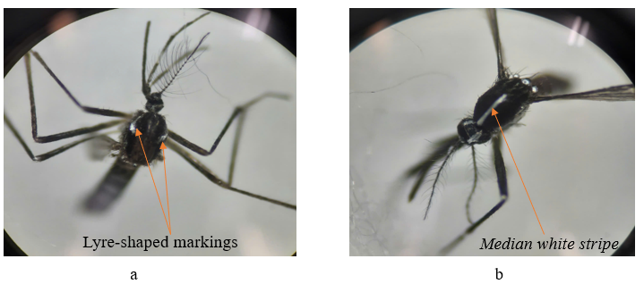
Figure 1. Characteristic features of Aedes mosquitoes: a) Ae. aegypti (lyre-shaped markings on the thorax) and b) Ae. albopictus (median white stripe along the thorax). Arrows indicate key morphological differences. (Photo by Nguyen Van Hiep)
Table 3. Numbers of Ae. aegypti and Ae. albopictus collected at the study sites
No | Sampling site | Ae. aegypti Field + F1 (n, %) | Ae. albopictus Field + F1 (n, %) | Total (n, %) |
1 | MuMD | 407 (23.16%) | 556 (28.43%) | 963 (25.94%) |
2 | MuBT | 396 (22.54%) | 327 (16.72%) | 723 (19.47%) |
3 | Mu7A | 373 (21.23%) | 323 (16.51%) | 696 (18.74%) |
4 | MuCC | 352 (20.03%) | 519 (26.53%) | 871 (23.46%) |
5 | MuCG | 229 (13.04%) | 231 (11.81%) | 460 (12.39%) |
Total | 1,757 (47.32%) | 1,956 (52.68%) | 3,713 | |
Identification of Ae. aegypti and Ae. albopictus Mosquitoes Using Molecular Biological Methods
Electrophoresis of PCR products on a 2% agarose gel showed clear and specific bands of the expected sizes in all samples: 252 bp for the 10 Ae. aegypti specimens (Figure 2a) and 438 bp for the 10 Ae. albopictus specimens (Figure 2b), as determined by comparison with a DNA ladder.
These molecular results were consistent with morphological identification, confirming the reliability of external morphological characteristics for distinguishing Ae. aegypti from Ae. albopictus.
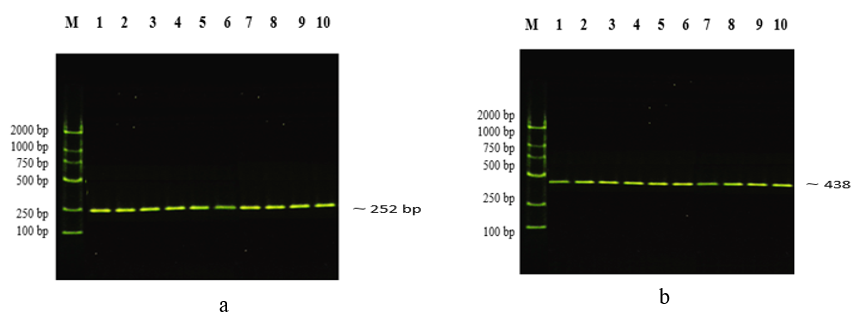
Figure 2. Agarose gel electrophoresis (2%) of PCR products: a) M: 2000 bp DNA marker; lanes 1–10: ITS2 amplicons of Ae. aegypti (expected size: 252 bp); b) M: 2000 bp DNA marker; lanes 1–10: ITS2 amplicons of Ae. albopictus (expected size: 438 bp)
Permethrin susceptibility bioassay results
According to WHO (2016) criteria, mosquito populations are classified as susceptible when 24-hour mortality is 98–100%, suspected resistant when mortality ranges from 90–97%, and resistant when mortality is below 90%. Classification was based on corrected 24-hour mortality rates using Abbott’s formula when necessary.
Susceptibility of Ae. aegypti to 0.75% Permethrin
The 0.75% permethrin bioassay showed that all Ae. aegypti populations from the five study sites were resistant. Corrected mortality rates ranged from 80.43% to 86.96%, remaining below the 90% threshold for resistance classification (Table 4). Mortality differences between each field population and the control group were statistically significant (Fisher’s exact test, p < 0.0001). Mortality values were relatively similar across sites, with mortality rates varying by up to 6.5%.
Table 4. Susceptibility of Ae. aegypti to 0.75% permethrin at five study sites
Parameter | Control | MuMD | MuBT | MuCC | Mu7A | MuCG |
Number tested (n) | 100 | 100 | 100 | 100 | 100 | 100 |
Corrected mortality (%) | 8.00 | 80.43 | 86.96 | 85.87 | 81.52 | 85.87 |
p-value (Fisher’s exact test) | – | <0.0001 | <0.0001 | <0.0001 | <0.0001 | <0.0001 |
Resistance status | – | Resistant | Resistant | Resistant | Resistant | Resistant |
Note: MuMD, MuBT, MuCC, Mu7A, and MuCG represent the study sites. Resistance status was determined according to WHO criteria. Mortality rates were corrected using Abbott's formula when control mortality was between 5% and 20%.
Susceptibility of Ae. albopictus to 0.75% Permethrin
Similarly, all Ae. albopictus populations were classified as resistant. Corrected mortality rates ranged from 84.45% to 88.89% (Table 5). Mortality differences between field populations and the control group were statistically significant (Fisher’s exact test, p < 0.0001). Mortality rates varyied by up to 4.4% between sites.
Table 5. Susceptibility of Ae. albopictus to 0.75% permethrin at five study sites
Parameter | Control | MuMĐ | MuBT | MuCC | Mu7A | MuCG |
Number tested (n) | 100 | 100 | 100 | 100 | 100 | 100 |
Corrected mortality (%) | 10.0 | 85.55 | 88.89 | 87.78 | 84.45 | 87.78 |
p-value (Fisher’s exact test) | – | <0.0001 | <0.0001 | <0.0001 | <0.0001 | <0.0001 |
Resistance status | – | Resistant | Resistant | Resistant | Resistant | Resistant |
Note: MuMD, MuBT, MuCC, Mu7A, and MuCG represent the study sites. Resistance status was determined according to WHO criteria. Mortality rates were corrected using Abbott's formula when control mortality was between 5% and 20%.
Both Ae. aegypti and Ae. albopictus exhibited resistance to permethrin at all study sites. Mortality rates were slightly higher in Ae. albopictus than in Ae. aegypti at most locations; however, all values remained below the WHO susceptibility threshold.
Investigation of Mutations in the VGSC Gene Encoding the Voltage-Gated Sodium Channel in Ae. aegypti and Ae. albopictus Collected in Ho Chi Minh City
Genomic DNA extracted from individual mosquitoes was used to amplify two target regions of the voltage-gated sodium channel (VGSC) gene: domain IIS6 and domain IIIS6. The expected amplicon sizes were approximately 750 bp (IIS6) and 650 bp (IIIS6). PCR products were resolved on a 2% agarose gel (Figure 3).
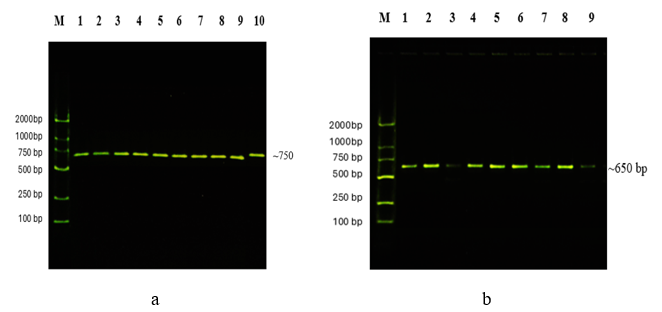
Figure 3. Agarose gel electrophoresis (2%) of VGSC amplicons: a) M: 2000 bp DNA marker; lanes 1–5 (Ae. aegypti), 6–10 (Ae. albopictus): IIS6 amplicons generated using primer pair AaSCF1/AaSCR4; b) M: 2000 bp DNA marker; lanes 1–5 (Ae. aegypti), 6–9 (Ae. albopictus): IIIS6 amplicons generated using primer pair AaSCF7/AaSCR7
All samples yielded clear single bands at the expected sizes, indicating specific amplification. The amplicon yield and quality were adequate for subsequent direct Sanger sequencing.
Detection of Kdr Mutations in the IIS6 and IIIS6 Fragments
All mutation analyses were performed exclusively on phenotypically permethrin-resistant individuals. For each species, 25 resistant specimens were sequenced in domain IIS6 and an independent set of 25 resistant specimens was sequenced in domain IIIS6.
Sanger sequencing identified wild-type, homozygous mutant, and heterozygous genotypes of the kdr F1534C mutation in domain IIIS6 of the VGSC gene in Aedes mosquitoes.
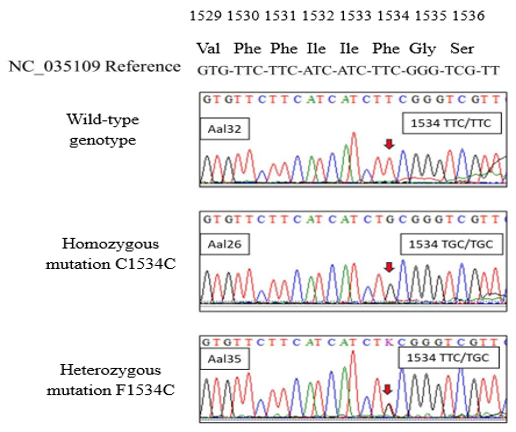
Figure 4. Sequencing chromatograms showing the genotypes at nucleotide position 1534 of the VGSC gene: wild-type (TTC/TTC), homozygous mutant (TGC/TGC), and heterozygous mutant (TTC/TGC) (from top to bottom)
Table 6. Distribution of kdr mutations in domains IIS6 and IIIS6 among permethrin-resistant Aedes mosquitoes
Species | IIS6 Mutation n (%) | IIS6 Wild type n (%) | Total | IIIS6 Mutation n (%) | IIIS6 Wild type n (%) | Total |
Ae. aegypti (n = 25) | 0 (0.0) | 25 (100.0) | 25 | 20 (80.0) | 5 (20.0) | 25 |
Ae. albopictus (n = 25) | 0 (0.0) | 25 (100.0) | 25 | 23 (92.0) | 2 (8.0) | 25 |
No known kdr-associated mutations were detected in domain IIS6 in either Ae. aegypti or Ae. albopictus, with all specimens exhibiting the wild-type sequence.
In contrast, mutations in domain IIIS6 were detected at high frequencies in both species. The mutation was present in 80.0% (20/25) of Ae. aegypti and 92.0% (23/25) of Ae. albopictus specimens.
Genotype and Allele Frequencies of the F1534C Mutation
Genotype and allele frequencies of the F1534C mutation in domain IIIS6 are presented in Table 7.
In Ae. aegypti, the homozygous mutant (CC) genotype was most frequent (44.0%), followed by heterozygous (FC) (36.0%) and wild-type (FF) (20.0%). The C allele frequency was 0.62 (95% CI: 0.49–0.75).
In Ae. albopictus, heterozygous (FC) and homozygous mutant (CC) genotypes predominated (48.0% and 44.0%, respectively), whereas wild-type (FF) was less common (8.0%). The C allele frequency was 0.68 (95% CI: 0.55–0.81).
Table 7. Genotype and allele frequencies of the F1534C mutation in domain IIIS6 of the VGSC gene among permethrin-resistant Aedes mosquitoes
Species | Wild type FF n (%) | Heterozygous mutation FC n (%) | Homozygous mutation CC n (%) | C allele frequency (95% CI) | p-value |
Ae. aegypti (n = 25) | 5 (20.0) | 9 (36.0) | 11 (44.0) | 0.62 (0.49–0.75) |
0.53
|
Ae. albopictus (n = 25) | 2 (8.0) | 12 (48.0) | 11 (44.0) | 0.68 (0.55–0.81) |
Note: Allele frequencies are presented with 95% confidence intervals (Wilson method).
Comparison of C allele frequencies between species revealed no statistically significant difference (χ² = 0.396, df = 1, p = 0.53).
Vector control remains one of the most effective strategies for preventing mosquito-borne diseases, including dengue fever, chikungunya, and Zika. Ae. aegypti and Ae. albopictus serve as the principal vectors. The World Health Organization (WHO) recommends pyrethroid insecticides, such as permethrin, for Aedes control due to their rapid knockdown and relatively low toxicity to humans. In Vietnam, pyrethroids have been widely used since the mid-1990s following the replacement of DDT. However, prolonged and repeated use may exert selective pressure on mosquito populations, thereby contributing to the development of resistance.
The present study demonstrates that both Ae. aegypti and Ae. albopictus populations from Ho Chi Minh City are resistant to 0.75% permethrin according to WHO (2016) criteria, with corrected 24-hour mortality rates ranging from 80.43% to 86.96% for Ae. aegypti and 84.45% to 88.89% for Ae. albopictus. These mortality levels are consistent with previous reports from Vietnam, where permethrin resistance in Ae. aegypti has been documented in major urban centers, including Hanoi and Ho Chi Minh City (Huynh & Minakawa, 2022; Thi et al., 2016). Compared with other Southeast Asian countries, the resistance intensity observed in the present study appears lower than that reported in Thailand and Indonesia, where mortality rates below 70% have frequently been documented (Amelia-Yap et al., 2018; Plernsub et al., 2016), but is comparable to findings from parts of Malaysia and Cambodia.
Molecular analysis revealed that the commonly reported kdr mutations in domain IIS6, including V1016G, S989P, and I1011M, were not detected. In contrast, the F1534C mutation in domain IIIS6 was detected at high frequency among phenotypically resistant individuals, with an 1534C allele frequencies of 0.62 in Ae. aegypti and 0.68 in Ae. albopictus. The absence of significant interspecific differences suggests that this mutation is widely established in urban Aedes populations in Ho Chi Minh City. Similar patterns have been reported in southern Vietnam and other parts of Asia, where F1534C is often the predominant kdr mutation associated with pyrethroid resistance (Kawada et al., 2009a; Yanola et al., 2011).
The detection of resistance in both major dengue vector species, together with the relatively high prevalence of the 1534C allele, highlights the importance of ongoing monitoring of pyrethroid effectiveness in Ho Chi Minh City. Strengthened routine resistance surveillance, combined with molecular monitoring of resistance-associated mutations, is therefore essential. In addition, implementing integrated resistance management strategies, including insecticide rotation and alternative control approaches, could help delay further resistance development and sustain vector control effectiveness.
Study Limitations
Several limitations should be acknowledged. First, sequencing was restricted to phenotypically resistant individuals; therefore, genotype-phenotype associations and population-level allele frequency estimates could not be determined. Second, Hardy-Weinberg equilibrium was not assessed due to the non-random sampling design. Third, the domains IIS6 and IIIS6 were sequenced in different individuals, which precluded the analysis of mutation co-occurrence and haplotypes. Finally, the inclusion of both F1 progeny and field-collected adults in the bioassays may have introduced variability in resistance estimates. Although this may have influenced the estimation of phenotypic resistance levels, its impact on the molecular detection of kdr mutations is expected to be minimal.
Conclusion
This study provides experimental evidence of permethrin resistance and associated VGSC mutations in Ae. aegypti and Ae. albopictus collected in Ho Chi Minh City. Bioassay results confirmed that both species are resistant to 0.75% permethrin, according to the World Health Organization (WHO, 2016), criteria, with corrected 24-hour mortality rates ranging from 80.43% to 86.96% in Ae. aegypti and from 84.45% to 88.89% in Ae. albopictus.
The commonly reported kdr mutations in domain IIS6, including V1016G, S989P, and I1011M, were not detected. In contrast, the F1534C mutation in domain IIIS6 was found at high frequency among phenotypically resistant individuals in both species. The comparable 1534C allele frequencies indicate that this mutation is similarly prevalent in permethrin-resistant populations of both Aedes species in Ho Chi Minh City, reflecting a shared resistance pattern.
Because mutation screening was restricted to resistant individuals, further investigations that include susceptible populations are needed to define better the strength of the association between F1534C and the resistant phenotype. These findings underscore the importance of continued insecticide resistance surveillance and molecular monitoring to support evidence-based vector control strategies in Ho Chi Minh City. They should inform public health policies for sustainable dengue prevention.
Funding: The authors express their gratitude to the Southern Branch of Joint Vietnam-Russia Tropical Science and Technology Research Center for its support and encouragement. This research was funded by the Southern Branch of Joint Vietnam-Russia Tropical Science and Technology Research Center (Project No. PN.Đ2.04/25).
Data Availability Statement: The datasets generated and/or analyzed during the current study are available in the GenBank repository under the accession numbers PZ225565–PZ225570.
Statement on the Use of Generative AI: The authors affirm that they did not use any artificial intelligence tools to create or edit the scientific content of this manuscript. All analysis, interpretation, and conclusions are entirely the work of the authors.
Author Contributions: Nguyen Van Hiep: Conceptualization, Methodology, Resources, Supervision, Funding Acquisition, Investigation, Data curation, Formal analysis, Visualization, Writing - Original Draft, Writing - Review & Editing, Project Administration. Dang Thi Ngoc Han, Nguyen Thi Dung, Huynh Viet Hang, Nguyen Tuan Long, Nguyen Duc Chung: Investigation. Tran Van Truong: Data curation, Formal analysis, Visualization, Writing - Original Draft, Writing - Review & Editing, Project Administration. Le Thanh Tan: Investigation, Data curation, Formal analysis. All authors have read and agreed to the published version of the manuscript.
Conflicts of interest statement: The authors declare no conflicts of interest.
References
Amelia-Yap, Z. H., Chen, C. D., Sofian-Azirun, M., & Low, V. L. (2018). Pyrethroid resistance in the dengue vector Aedes aegypti in Southeast Asia: Present situation and prospects for management. Parasites & Vectors, 11(1), 332. https://doi.org/10.1186/s13071-018-2899-0
Bang, W. J., Won, M. H., Cho, S. T., Ryu, J., & Choi, K. S. (2021). A multiplex PCR assay for six Aedini species, including Aedes albopictus. Parasites & Vectors, 14(1), 380. https://doi.org/10.1186/s13071-021-04871-7
Bhatt, S., Gething, P. W., Brady, O. J., Messina, J. P., Farlow, A. W., Moyes, C. L., Drake, J. M., Brownstein, J. S., Hoen, A. G., Sankoh, O., Myers, M. F., George, D. B., Jaenisch, T., Wint, G. R. W., Simmons, C. P., Scott, T. W., Farrar, J. J., & Hay, S. I. (2013). The global distribution and burden of dengue. Nature, 496(7446), 504–507. https://doi.org/10.1038/nature12060
Brengues, C., Hawkes, N. J., Chandre, F., McCarroll, L., Duchon, S., Guillet, P., Manguin, S., Morgan, J. C., & Hemingway, J. (2003). Pyrethroid and DDT cross-resistance in Aedes aegypti is correlated with novel mutations in the voltage-gated sodium channel gene. Medical and Veterinary Entomology, 17(1), 87–94. https://doi.org/10.1046/j.1365-2915.2003.00412.x
Huynh, T. T. T., & Minakawa, N. (2022). A comparative study of dengue virus vectors in major parks and adjacent residential areas in Ho Chi Minh City, Vietnam. PLoS Neglected Tropical Diseases, 16(1), e0010119. https://doi.org/10.1371/journal.pntd.0010119
Kasai, S., Caputo, B., Tsunoda, T., Cuong, T. C., Maekawa, Y., Lam-Phua, S. G., Pichler, V., Itokawa, K., Murota, K., Komagata, O., Yoshida, C., Chung, H. H., Bellini, R., Tsuda, Y., Teng, H. J., Filho, J. L. L., Alves, L. C., Ng, L. C., Minakawa, N., ... Tomita, T. (2019). First detection of a Vssc allele V1016G conferring a high level of insecticide resistance in Aedes albopictus collected from Europe (Italy) and Asia (Vietnam), 2016: A new emerging threat to controlling arboviral diseases. Eurosurveillance, 24(5), 1700847. https://doi.org/10.2807/1560-7917.ES.2019.24.5.1700847
Kasai, S., Ng, L. C., Lam-Phua, S. G., Tang, C. S., Itokawa, K., Komagata, O., Kobayashi, M., & Tomita, T. (2011). First detection of a putative knockdown resistance gene in major mosquito vector, Aedes albopictus. Japanese Journal of Infectious Diseases, 64(3), 217–221. https://doi.org/10.7883/yoken.64.217
Kawada, H., Higa, Y., & Kasai, S. (2023). Reconsideration of importance of the point mutation L982W in the voltage-sensitive sodium channel of the pyrethroid-resistant Aedes aegypti (L.) (Diptera: Culicidae) in Vietnam. PLOS ONE, 18(5), e0285883. https://doi.org/10.1371/journal.pone.0285883
Kawada, H., Higa, Y., Komagata, O., Kasai, S., Tomita, T., Thi Yen, N., Loan, L. L., Sánchez, R. A., & Takagi, M. (2009). Widespread distribution of a newly found point mutation in voltage-gated sodium channel in pyrethroid-resistant Aedes aegypti populations in Vietnam. PLoS Neglected Tropical Diseases, 3(10), e527. https://doi.org/10.1371/journal.pntd.0000527
Kawada, H., Higa, Y., Nguyen, Y. T., Tran, S. H., Nguyen, H. T., & Takagi, M. (2009). Nationwide investigation of the pyrethroid susceptibility of mosquito larvae collected from used tires in Vietnam. PLoS Neglected Tropical Diseases, 3(3), e391. https://doi.org/10.1371/journal.pntd.0000391
Menegon, M., Severini, F., Toma, L., Martignoni, M., & Di Luca, M. (2025). Rapid molecular method for early detection of the invasive mosquito Aedes aegypti (Linnaeus, 1762) at points of entry. Acta Tropica, 264, 107605. https://doi.org/10.1016/j.actatropica.2025.107605
Plernsub, S., Saingamsook, J., Yanola, J., Lumjuan, N., Tippawangkosol, P., Walton, C., & Somboon, P. (2016). Temporal frequency of knockdown resistance mutations, F1534C and V1016G, in Aedes aegypti in Chiang Mai City, Thailand and the impact of the mutations on the efficiency of thermal fogging spray with pyrethroids. Acta Tropica, 162, 125–132. https://doi.org/10.1016/j.actatropica.2016.06.019
Plernsub, S., Saingamsook, J., Yanola, J., Lumjuan, N., Tippawangkosol, P., Sukontason, K., Walton, C., & Somboon, P. (2016). Additive effect of knockdown resistance mutations, S989P, V1016G and F1534C, in a heterozygous genotype conferring pyrethroid resistance in Aedes aegypti in Thailand. Parasites & Vectors, 9(1), 417. https://doi.org/10.1186/s13071-016-1713-0
Saavedra-Rodriguez, K., Urdaneta-Marquez, L., Rajatileka, S., Moulton, M., Flores, A. E., Fernandez-Salas, I., Bisset, J., Rodriguez, M., McCall, P. J., Donnelly, M. J., Ranson, H., Hemingway, J., & Black, W. C., IV. (2007). A mutation in the voltage-gated sodium channel gene associated with pyrethroid resistance in Latin American Aedes aegypti. Insect Molecular Biology, 16(6), 785–798. https://doi.org/10.1111/j.1365-2583.2007.00774.x
Thi, K. P., Viet, H. H., & Nguyen, H. M. (2016). Major resistant mechanism to insecticides of Aedes aegypti mosquito: A vector of dengue and Zika virus in Vietnam. SM Tropical Medicine Journal, 1(2), 1010. https://doi.org/10.36876/smtmj.1010
Vontas, J., Kioulos, E., Pavlidi, N., Morou, E., Della Torre, A., & Ranson, H. (2012). Insecticide resistance in the major dengue vectors Aedes albopictus and Aedes aegypti. Pesticide Biochemistry and Physiology, 104(2), 126–131. https://doi.org/10.1016/j.pestbp.2012.05.008
World Health Organization. (2016). Monitoring and managing insecticide resistance in Aedes mosquito populations: Interim guidance for entomologists (WHO Reference Number WHO/ZIKV/VC/16.1). World Health Organization.
Yanola, J., Somboon, P., Walton, C., Nachaiwieng, W., Somwang, P., & Prapanthadara, L. A. (2011). High-throughput assays for detection of the F1534C mutation in the voltage-gated sodium channel gene in permethrin-resistant Aedes aegypti and the distribution of this mutation throughout Thailand. Tropical Medicine & International Health, 16(4), 501–509. https://doi.org/10.1111/j.1365-3156.2011.02725.x
Zhao, C., Zhou, X., Xue, C., Lun, X., Li, W., Liu, X., Wu, H., Song, X., Wang, J., Liu, Q., & Meng, F. (2023). Knockdown resistance mutations distribution and characteristics of Aedes albopictus field populations within eleven dengue local epidemic provinces in China. Frontiers in Cellular and Infection Microbiology, 12, 981702. https://doi.org/10.3389/fcimb.2022.981702