

Assessment of the current status of floristic diversity in Song Hinh - Tay Hoa protection forests
Main Article Content
Abstract
Understanding the current status of plant diversity in tropical forests is fundamental for developing effective strategies for conservation and sustainable management. This study assessed the floristic composition and diversity of the Song Hinh - Tay Hoa protection forests, a representative tropical ecosystem in south-central Vietnam. Field surveys followed by taxonomic identification recorded 1,163 species of vascular plants, belonging to four divisions, 175 families, and 679 genera. Angiosperms were overwhelmingly dominant (93.7%), with Euphorbiaceae, Fabaceae, and Moraceae identified as the most diverse families, reflecting a typical tropical forest structure. Analysis of life-form spectra revealed that phanerophytes constituted 79.45% of the flora, mainly mesophanerophytes and nanophanerophytes, a characteristic feature of humid tropical forests. The dominance of phanerophytes indicates a stable ecosystem with limited degradation. Floristic elements were mainly represented by the Indo-Malesian group (58.38%), confirming both the humid tropical nature of the vegetation and the transitional biogeographical position of the area - i.e., a junction where Indochinese (continental SE Asian) lineages overlap with Southern Chinese/East Asian and Malesian (insular SE Asian) floras. Importantly, 41 species of high conservation concern were documented, with many categorized from Critically Endangered to Vulnerable under the IUCN Red List (2025), the Vietnam Red Data Book 2024, and Circular 27/2025/TT-BNNMT. The presence of a relatively high proportion of Vietnamese endemic species (8.60%) further emphasizes the conservation significance of this forest as a biodiversity hotspot within tropical Asia. These findings underscore the urgent need to maintain forest cover, restrict overexploitation, and monitor life-form spectra as indicators of ecosystem health. By providing a comprehensive baseline of floristic diversity, this study offers essential evidence to guide biodiversity conservation, support sustainable forest management, and enhance resilience to climate change in the region.
Keywords
Flora diversity, conservation value, life-form prevalence, protected forest, Song Hinh - Tay Hoa
Article Details

This work is licensed under a Creative Commons Attribution 4.0 International License.
- Highlights:
A comprehensive floristic survey in Song Hinh - Tay Hoa protection forests was conducted, documenting 1163 species of vascular plant across four divisions and 175 families.
Angiosperms predominate (93.7%), with Euphorbiaceae, Fabaceae and Moraceae being the most diverse families.
Life-form analysis reveals 79.45% phanerophytes (chiefly mesophanerophytes and nanophanerophytes), indicating a stable ecosystem of humid tropical forest.
Indo‑Malesian species contribute 58.38% of the flora; 41 species are identified as Critically Endangered to Vulnerable, emphasizing urgent conservation needs.
A rate of 8.60% species endemic to Vietnam classifies Song Hinh - Tay Hoa protection forests as a tropical Asian biodiversity hotspot requiring priority protection.
1. INTRODUCTION
Diversity of plant communities plays a crucial role in shaping and maintaining ecosystem functions, contributing to resource provision, ecological balance, and the support of the overall biodiversity [1]. A wide range of plant species contribute to processes that sustain ecosystem functioning, thereby enhancing system stability and productivity [2, 3]. Experimental studies have demonstrated that species-rich communities often perform more efficiently. Species-diverse floras exhibit higher biological productivity, improved nutrient retention and cycling, and provide multiple essential ecosystem services [4, 5]. Consequently, the decline of species richness can lead to the reduction of critical functions such as biomass production, soil regeneration, and climate regulation [6]. Diverse plant communities also generate more nutrient-rich soils, store greater amounts of carbon, and display higher cation exchange capacity compared to the species-poor communities [7].
Research on floristic diversity not only serves to catalogue species but also provides fundamental insights for resource management and ecological conservation. Floristic inventories enable the identification of rare and endangered species and their distributions, forming the basis for conservation planning and for recommending enhanced protection of forests with high biodiversity value [8, 9]. In Vietnam - a country recognized as a global biodiversity hotspot yet whose ecosystems remain vulnerable to anthropogenic activities and developmental pressures - biodiversity research extends beyond academic interest. It has become an essential foundation for conservation, offering systematic scientific knowledge to support the protection, restoration, and sustainable management of valuable biological resources. This ensures the maintenance of key ecosystem services, thereby sustaining human livelihoods and contributing to national sustainable development [10, 11].
The Deo Ca - Hon Vong Phu mountain range, located between southern part of Phu Yen Province and northern part of Khanh Hoa Province, represents a transitional zone from the eastern Annamite slopes to the coastal plains, characterized by a varied topography of peaks interspersed with fertile valleys. The Song Hinh - Tay Hoa protection forests, situated on the western and southwestern slopes of this range, includes low-mountain evergreen broadleaf forests and watershed protection forests of the Hinh and Ba rivers. The mountain-valley landscape, combined with a tropical monsoon climate and the transitional position between the South Central Coast and Southeastern floristic regions, has fostered a rich vegetation composition, particularly the understory flora. In recent years, the discovery of new plant species has highlighted Song Hinh - Tay Hoa protection forests as a biodiversity hotspot in central Vietnam. Furthermore, reports of rare reptiles, birds, and mammals in the same area underscore the ecological biodiversity of this forest. In recent years, several botanical studies have been conducted in the Song Hinh - Tay Hoa protection forests, recording numerous rare species and revealing multiple taxa new to science, such as Peliosanthes multiflora, Vanilla cardinalis, Newmania sessilanthera, and Billolivia citrina. Newly recorded genera and species for Vietnam, including Hullettia dumosa and Habenaria coultousii, have also been documented. Genetic analyses of Cinnamomum parthenoxylon further highlight the conservation significance of the Song Hinh population [12-15].
However, previous studies have mainly focused on species descriptions, local distribution records, or small-scale genetic assessments. A comprehensive evaluation of the vegetation structure, floristic composition, and overall plant diversity of the entire Song Hinh - Tay Hoa forest complex is still lacking. This gap underscores the need for more systematic, landscape-level investigations to clarify species distribution patterns, floristic richness, and the ecological significance of this area. Despite its high biological value, the Song Hinh - Tay Hoa protection forests are under increasing pressure from logging, illegal road construction, and land-use conversion. Against this backdrop, assessing the current status of plant diversity in this forest has become imperative to clarify species composition, vegetation structure, conservation significance, and potential threats. The findings will provide a scientific basis for conservation planning, medicinal plant development, and sustainable forest management in the region.
2. Materials and Methods
2.1. Study area
The study was conducted from January 2024 to March 2025 in the Song Hinh and Tay Hoa protection forests, located on the western and southwestern slopes of the Deo Ca - Hon Vong Phu mountain range in south-central Vietnam (Figure 1). The research area covers more than 52,000 hectares, dominated by evergreen broadleaf forests primarily distributed above 400 m elevation. The region is characterised by a mountain - valley landscape under a tropical monsoon climate, with high annual rainfall and distinct seasonality [15]. To verify current field identifications, the contemporary floristic composition was cross-referenced against regional herbarium collections housed at Da Lat University (Herbarium), the Biology Museum (VNU), and the Institute of Forest Science for South Central Viet Nam and the Central Highlands.
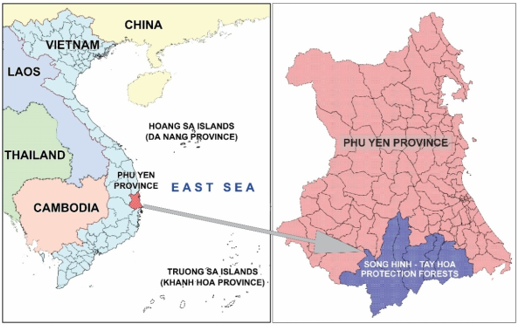
Figure 1. Location map of the study area
2.2. Data collection
We conducted four field campaigns (Jan 2024–Mar 2025) spanning both wet and dry seasons. All records (field notes, photographs, georeferences) were digitised into a standard database to support compilation of the floristic checklist and analyses of the life-form spectrum and phytogeographical elements. Reconnaissance transects were laid out to ensure comprehensive coverage of representative habitats (Figure 2): (I) Song Hinh Protection Forest - four transects: (1) Thuong Nghe River corridor; (2) Thuong Nghe River - 900 m summit; (3) Song Hinh hydropower reservoir - Thuong Nghe River (Survey Route 3); (4) Forest Guard Station No. 1 - Lanh Stream; (II) Tay Hoa Protection Forest - three transects: (5) Patrol route of Forest Guard Station No. 2; (6) Dong Mau Hamlet - 1370 m summit; (7) Viettel broadcast station - 900 m summit.
Transects were positioned to represent the main habitat types (low-mountain evergreen broadleaf forest, riparian forest, slope-ridge complexes, forest edges/secondary regeneration), elevation, slope, and aspect. Ridge-valley cross-sections were prioritised to capture microclimatic gradients. Each transect followed natural landforms; start/end points, length, elevation, and habitat were georeferenced with handheld GPS (WGS84).
Along each transect, we established a 20 m-wide belt (10 m on either side of the line). All vascular plant taxa encountered within the belt were recorded with a provisional field identification, the coordinates of the first encounter, and the corresponding habitat. For taxa with uncertain determination or of conservation interest, herbarium vouchers were collected (branch material with leaves and, where available, flowers/fruit), with full labels (collector code, date/time, habitat description, coordinates and elevation). Vouchers were subsequently cross-checked against regional reference collections at Da Lat University, the Forest Science Institute of Central Highlands and South of Central Vietnam, and the Museum of Biology, University of Science, to verify determinations and assess intraspecific variation within the local range.
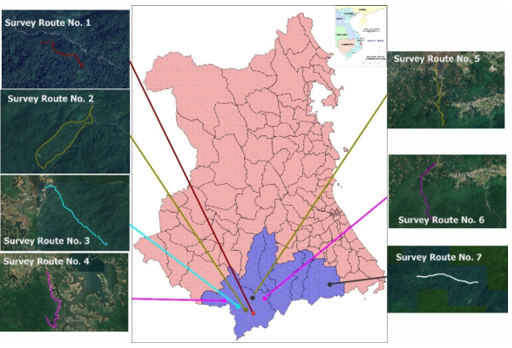
Figure 2. Location of survey routes
2.3. Data analysis
2.3.1. Species identification
The botanical specimens were identified using standard taxonomic sources, including An Illustrated Flora of Vietnam [16], Timber Resources of Vietnam [17], and the continually updated Flora of Vietnam series [18,14]. Identification also involved comparing the field collections with authenticated voucher specimens preserved in herbaria and with digitised images of type specimens available from online repositories. Nomenclature was cross‑checked against the accepted names listed in Plants of the World Online (POWO), with synonyms noted and taxonomy updated to reflect POWO classification.
2.3.2. Statistical analysis
Based on the field surveys and the compiled floristic checklist, several analytical criteria were applied to evaluate species diversity and conservation value:
a) Species richness: descriptive statistics of taxonomic composition, including the number of species, genera, and families.
b) Life-form spectrum and phytogeographical elements: classification of life forms according to Raunkiær’s system [19], and determination of geographical elements based on the classification system of Nguyen Nghia Thin [20].
c) Conservation value assessment: evaluation of conservation status following the IUCN Red List (2025), the Vietnam Red Data Book (2024), and Circular No. 27/2025/TT-BNNMT (24 June 2025) issued by the Ministry of Agriculture and Environment, which regulates the management of endangered, precious, and rare species, the keeping of common forest animals, and the implementation of CITES.
3. RESULTS
3.1. Diversity of species composition
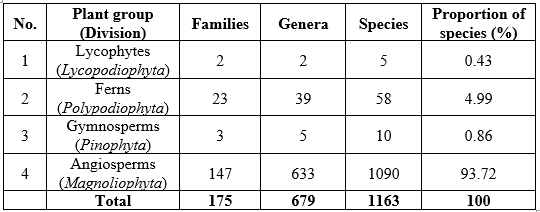
The results of field surveys and taxonomic identification confirmed that the flora of the Song Hinh - Tay Hoa protection forests comprise 1,163 species belonging to four divisions: Lycopodiophyta, Polypodiophyta, Pinophyta, and Magnoliophyta. Among these, angiosperms (Magnoliophyta) were by far the most diverse, with 147 families, 633 genera, and 1,090 species, accounting for 93.72% of the total flora. Pteridophytes (Polypodiophyta) were represented by 23 families, 39 genera, and 58 species (4.99%), while gymnosperms (Pinophyta) comprised only 3 families, 5 genera, and 10 species (0.86%). Lycophytes (Lycopodiophyta) were the least diverse group, with 2 families, 2 genera, and 5 species (0.43%) (Table 1).
Table 1. Diversity of plant species composition in the Song Hinh - Tay Hoa protection forests
Among the 175 vascular plant families recorded in the Song Hinh - Tay Hoa protection forests, several families were found to be particularly species-rich. Euphorbiaceae contained the highest number of species (51), with highly diverse genera such as Acalypha, Alchornea, Cleidion, Croton, Glochidion, and Phyllanthus. Fabaceae ranked second with 49 species, represented by large genera including Dalbergia, Erythrina, Cajanus, Millettia, Senna, and Cassia. Moraceae comprised 21 species, with remarkable diversity in the genus Ficus (14 species), in addition to genera such as Streblus and Artocarpus. Vitaceae was represented by 20 species, including the genera Ampelocissus, Cissus, Leea, Tetrastigma, and Vitis. Asteraceae accounted for 16 species, represented by genera such as Decaneuropsis, Elephantopus, Blumea, Emilia, and Vernonia.
At the genus level, Ficus (Moraceae) was the most diverse, with 14 species commonly encountered in tropical forests. The genus Croton (Euphorbiaceae) followed with 9 species, encompassing trees, shrubs, and herbs that typify the ecological adaptability of the family. Three genera - Lygodium (climbing ferns characteristic of humid tropical habitats), Desmodium, and Bauhinia (both Fabaceae with wide distribution and notable ecological and medicinal value) - each contained 6 species. An integrated analysis at the family and genus levels revealed an average ratio of approximately 6.6 species per family and 1.7 species per genus.
3.2. Life-form spectrum and phytogeographical elements
The flora of the Song Hinh - Tay Hoa protection forests comprises a total of 1,163 species, classified into five life-form categories. Phanerophytes (trees and tall shrubs) were overwhelmingly dominant, with 924 species representing 79.45% of the total flora. Cryptophytes (species with subterranean storage organs such as roots, rhizomes, tubers, or bulbs) ranked second with 97 species (8.34%). Hemicryptophytes (herbaceous species with perennating buds at the soil surface) included 68 species, accounting for 5.85%. Therophytes (annual plants) comprised 42 species (3.61%). Chamaephytes (dwarf shrubs and ground-level woody plants) formed the smallest group with 32 species (2.75%) (Table 2).
Table 2. Life-form spectrum of the flora in the Song Hinh - Tay Hoa protection forests
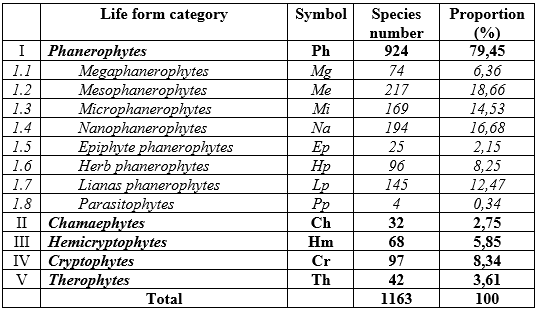
Analysis of the 924 phanerophyte species revealed eight subgroups. Mesophanerophytes (medium-sized trees 8 - 30 m in height) were the most abundant, with 217 species (18.66% of the total flora). Nanophanerophytes (small trees under 2 m tall) ranked second, comprising 194 species (16.68%). Microphanerophytes (trees 2 - 8 m in height) accounted for 169 species (14.53%). Liana phanerophytes (woody climbers) included 145 species (12.47%). Herbaceous phanerophytes (herbaceous plants with woody characteristics) were represented by 96 species (8.25%). Megaphanerophytes (tall trees >30 m) comprised 74 species (6.36%). Epiphytic phanerophytes (woody plants growing on other trees) accounted for 25 species (2.15%). The rarest subgroup was parasitophytes (parasitic plants), with only 4 species (0.34%).
Accordingly, the general life-form spectrum formula of the flora in the Song Hinh - Tay Hoa protection forest can be expressed as:
Natural spectrum = 79.45Ph + 2.75Ch + 5.85Hm + 8.34Cr + 3.61Th (1)
For the phanerophyte group, the life-form spectrum can be expressed by the following formula:
79.45Ph = 6.36Mg + 18.66Me + 14.53Mi + 16.68Na + 2.15Ep + 8.25Hp +12.47Lp + 0.34Pp (2)
Overall, the data indicate that the vegetation structure in the study area is dominated by woody species across multiple height classes, with medium-sized trees and low shrubs forming the majority. Liana phanerophytes (woody climbers) and herbaceous phanerophytes also contributed substantially, reflecting the structural complexity and life-form diversity within the woody layer of the forest.
The analysis revealed that the flora of the Song Hinh - Tay Hoa protection forests is represented by seven phytogeographical element groups (Table 3). The species composition is concentrated predominantly in the Indo-Malesian tropical element, which comprises 679 species, accounting for 58.38% of the total flora. Within this group, the Southeast Asian - Malesian element was the most prominent with 227 species (19.52%), followed by the general Asian tropical element with 139 species (11.95%), alongside sub-elements associated with India, the Himalayas, southern China, and Indochina endemics.
The Paleotropical group included 193 species (16.60%), with the Asian - Australian and Asian - African elements contributing 8.43% and 4.04%, respectively. The Pantropical group was represented by 131 species (11.26%), consisting of species with a wide distribution across the global tropics. The North Temperate element accounted for only 38 species (3.27%), mainly belonging to the East Asian and East Asian - North American elements.
According to Nguyen Nghia Thin’s classification of phytogeographical elements [20], Vietnamese endemic elements in the study area comprise 100 species (8.60%), including 68 strict endemics confined to Vietnam (5.85%) and 32 subendemics (2.75%) occurring in Vietnam and adjacent Indochinese border areas. Cosmopolitan elements are represented by 14 species (1.20%), while cultivated plants constitute the smallest category, with only 8 species (0.69%).
Table 3. Phytogeographical element groups of the flora in the Song Hinh - Tay Hoa protection forests
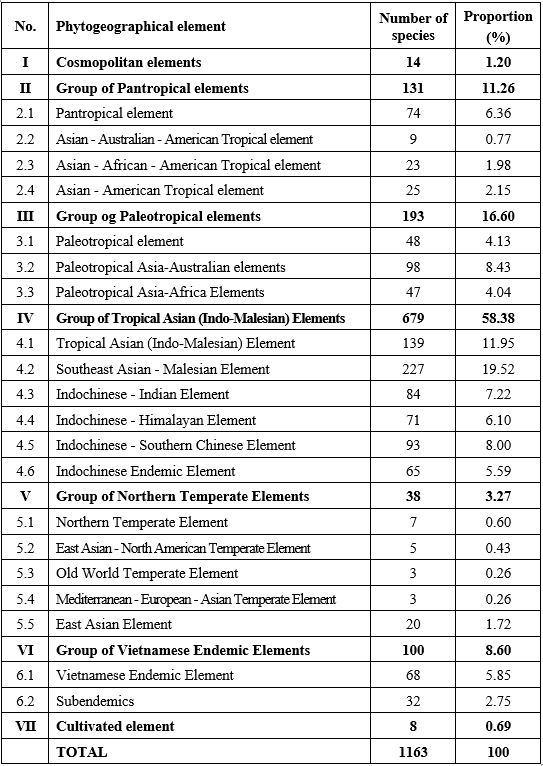
In contrast, temperate elements accounted for only a small proportion (~3%), indicating the limited influence of temperate climate on the flora of this area, which is strongly shaped by the tropical monsoon regime. The presence of 14 cosmopolitan species and 8 cultivated species further highlights the coexistence of native taxa with some widely distributed or human-introduced species.
Notably, the proportion of Vietnamese endemic species is relatively high, suggesting that the Song Hinh - Tay Hoa protection forests are an area with significant conservation potential. The discovery of numerous species endemic or subendemic species here reinforces the critical role of this protection forest not only in disaster prevention but also in the conservation of Vietnam’s rare and valuable plant genetic resources.
3.4. Conservation status and species of high conservation value
A total of 41 plant species of conservation concern were recorded in the Song Hinh - Tay Hoa protection forest (Table 4), of which 13 species have been assessed by the IUCN, 33 species are listed in the Vietnam Red Data Book (VRDB 2024), and 16 species are subject to regulation under Circular No. 27/2025/TT-BTNMT (TT27) on endangered and rare species management.
Table 4. Conservation status and value of the flora in the Song Hinh - Tay Hoa protected forests
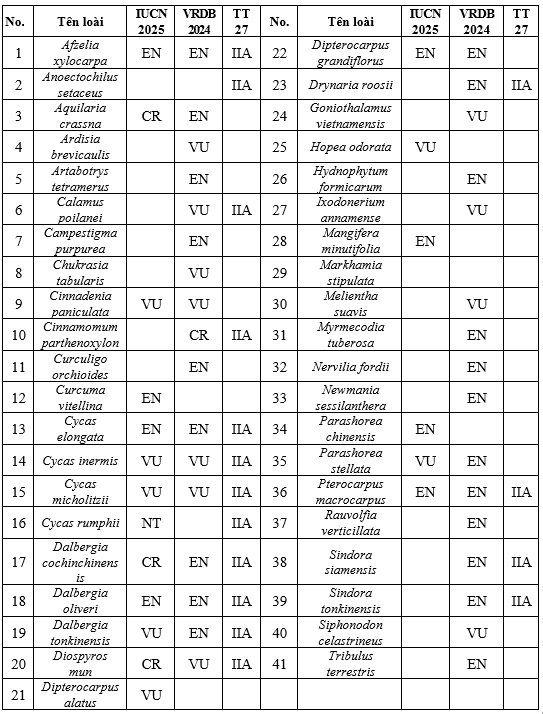
According to the IUCN Red List (2025), there are three Critically Endangered (CR) species: Aquilaria crassna, Dalbergia cochinchinensis, and Diospyros mun; eight Endangered (EN) species, including Afzelia xylocarpa and Dipterocarpus grandiflorus; seven Vulnerable (VU) species such as Cinnadenia paniculata, Cycas inermis, Cycas micholitzii, Dalbergia tonkinensis, Dipterocarpus alatus, Hopea odorata, and Parashorea stellata; and one Near Threatened (NT) species (Cycas rumphii). The remaining species have not yet been globally evaluated.
In the Vietnam Red Data Book (2024), one species is classified as Critically Endangered (CR) (Cinnamomum parthenoxylon), 21 species are Endangered (EN), and 11 species are Vulnerable (VU). Most of the valuable timber species, including Afzelia xylocarpa, Dalbergia spp., and Pterocarpus macrocarpus, fall into the EN category.
According to Circular No. 27/2025, 16 species is listed in Group IIA (restricted exploitation), including several valuable timber species such as Afzelia xylocarpa, Cycas spp., Dalbergia spp., Diospyros mun, Pterocarpus macrocarpus, and Sindora siamensis, highlighting their high conservation priority.
4. DISCUSSION
4.1. Characteristics of flora in Song Hinh - Tay Hoa protection forest
The survey results revealed that the angiosperms (Magnoliophyta) overwhelmingly dominated the flora of the Song Hinh - Tay Hoa protection forests, accounting for 93.72% of the total species. This predominance reflects the global trend in plant diversity: phylogenomic analyses indicate that flowering plants represent at least 95% of all vascular plant species, whereas ferns, mosses, and lycophytes contribute only a minor fraction [21]. This explains why ferns (4.99%), gymnosperms (0.86%), and lycophytes (0.43%) play only supplementary roles in ecosystem structure rather than serving as dominant components. Such a composition is consistent with the general pattern observed in tropical rainforests, where angiosperms usually achieve absolute dominance.
Species diversity was concentrated in several large families, most notably Euphorbiaceae (51 species) and Fabaceae (49 species). This reflects the evolutionary success of these two families in tropical regions. Chloroplast genome studies highlight Euphorbiaceae as one of the largest angiosperm families, with approximately 300 genera and nearly 7500 species [22]; its high diversity is supported by a wide range of life forms (trees, shrubs, herbs, and climbers) and strong ecological adaptability. Similarly, genomic analyses report that Fabaceae includes about 20,000 species and is the third largest family among vascular plants, making phylogenomic studies particularly challenging [23]. In Song Hinh - Tay Hoa protection forests, the richness of genera such as Dalbergia, Millettia, Cassia, and Senna highlights the ecological and economic importance of this family, which provides valuable timber, contributes to soil improvement through nitrogen fixation, and supplies food and medicinal resources. Moraceae was represented by 21 species, with Ficus being particularly diverse (14 species). Ficus is widely recognized as a keystone genus in tropical forests, as its figs provide a stable fruit resource for birds, bats, and primates, thereby sustaining frugivore populations [24]. The presence of Asteraceae, with light-demanding species such as Blumea and Vernonia, demonstrates the adaptability of heliophilous plants to nutrient-poor soils and disturbed habitats.
At the genus level, the study area recorded an average of 6.6 species per family and 1.7 species per genus, indicating a relatively even distribution of species rather than a concentration in only a few genera. The genus Croton (Euphorbiaceae) was the most diverse with 9 species, while Lygodium, Bauhinia, and Desmodium each contributed 6 species, reflecting the diversity of climbers and shrubs within the fern and legume families. These calculations demonstrate that the Song Hinh - Tay Hoa protection forests supports a structurally diverse vegetation composition, combining large trees, shrubs, climbers, and herbaceous plants to form the multilayered ecosystem typical of tropical rainforests.
Thus, the flora of Song Hinh - Tay Hoa protection forests not only mirrors the global evolutionary trend of plant diversity (the dominance of angiosperms) but also represents a microcosm of the Indochinese - Malesian tropical rainforest, where many large families converge to create exceptional diversity. The presence of species-rich families and keystone genera such as Ficus underscores the ecological and conservation significance of the area: these taxa provide food, timber, non-timber forest products, and vital ecosystem services for both wildlife and local communities. At the same time, although ferns, gymnosperms, and lycophytes account for only a small proportion of the flora, they nevertheless contribute to maintaining the evolutionary integrity of the plant community. These findings strongly recommend strengthening forest protection and restoration efforts to sustain both high species richness and complex ecological structure - a valuable resource for scientific research, medicine, and sustainable development.
4.2. The life-form spectrum characteristics
The plant life-form spectrum is an essential ecological indicator, reflecting the relative contribution of different life-form groups to plant communities and their relationships with the environment, thereby allowing the characterization of ecosystem climate types [25, 26]. At the same time, the life-form spectrum illustrates how plant communities are shaped by the survival strategies of individual species in response to climatic and edaphic conditions [27]. In many specific studies, the life-form spectrum is not only a tool for classification but also a useful indicator for monitoring ecological change, comparing plant communities, and applying biodiversity conservation strategies [28, 29]. The results from the Song Hinh - Tay Hoa protection forests show a strong bias toward phanerophytes, indicating that the community is influenced by a phanerophytic climate (humid, warm, and forested), consistent with Raunkiaer’s assertion that a high proportion of phanerophytes reflects rainforest or evergreen forest conditions [19]. This distribution pattern clearly demonstrates the predominance of woody life forms in the community structure compared with other life-form categories, reflecting the ecological characteristics of tropical evergreen forests, where phanerophytes typically dominate. To identify similarities and differences with other floristic systems in Vietnam, the flora of the Song Hinh - Tay Hoa protected forests was compared with that of several other regions in the country (Table 5).
Table 5. Comparison of the plant life-form spectrum between flora of the Song Hinh - Tay Hoa protection forests and selected regions in Vietnam
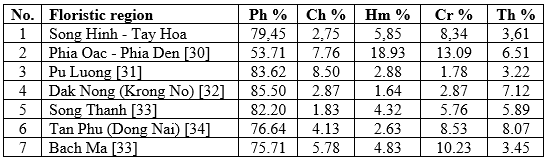
Comparison of the life-form spectrum of flora of the Song Hinh - Tay Hoa protection forests with other regions reveals both similarities and notable differences. The proportion of phanerophytes at Song Hinh - Tay Hoa reached 79.45%, higher than in Bach Ma (75.71%) and Tan Phu (76.64%), but lower than in Pu Luong (83.62%), Song Thanh (82.20%), and Dak Nong (85.50%). This indicates that the Song Hinh - Tay Hoa protection forests retain the characteristics of a humid tropical forest dominated by woody species, though its canopy coverage and structural stability appear somewhat lower than in primary forests such as Pu Luong or Song Thanh.
Regarding other life-form groups, cryptophytes accounted for 8.34% at Song Hinh - Tay Hoa protection forests, a value comparable to Tan Phu (8.53%) and slightly lower than Bach Ma (10.23%), reflecting the persistence of subterranean-bud species under seasonal drought and disturbed conditions. In contrast, hemicryptophytes made up only 5.85%, far lower than the extremely high level in Phia Oac - Phia Den (78.93%), underscoring the climatic and topographic differences between lowland tropical and high-altitude subtropical ecosystems. Therophytes at Song Hinh - Tay Hoa protection forests (3.61%) were fewer than in Tan Phu (8.07%) and Dak Nong (7.11%), suggesting that disturbance and grassland expansion are less severe than in areas subject to stronger anthropogenic impacts.
Overall, the life-form spectrum of Song Hinh - Tay Hoa protection forests represents an intermediate profile: it preserves the tropical rainforest signature dominated by phanerophytes, yet shows an increase in cryptophytes and therophytes, reflecting the influence of ecological conditions and certain human activities. This pattern differs from both more stable primary forests and the distinctive high-altitude ecosystems. These findings are consistent with studies in semi-evergreen forests of Cameroon, where phanerophytes - particularly mesophanerophytes - dominate in both logged and primary forests [35]. By contrast, studies in semi-arid or heavily disturbed regions, such as the Chichawatni plantations and the vegetation of Bin Dara - Dir (Pakistan), found therophytes to be dominant (44 - 50%) and phanerophytes to account for only 12 - 19%, with the dominance of therophytes explained by grazing pressure, cultivation, and arid climates [26]. Such comparisons affirm that the Song Hinh - Tay Hoa protection forests is relatively undisturbed and situated within a warm, humid climatic regime.
Flora of the Song Hinh - Tay Hoa protection forests exhibits a high proportion of mesophanerophytes, alongside a substantial presence of micro- and nanophanerophytes, liana phanerophytes, and herbaceous phanerophytes. This pattern reflects a multilayered canopy structure formed by an intermix of mid-sized trees, tall shrubs, small trees, woody climbers, and herbaceous-woody life forms. The occurrence of 25 epiphytic phanerophyte species (2.71%) and 4 parasitophyte (parasitic plant) species (0.43%) indicates humid microclimates and the persistence of specialised microhabitats. The proportion of megaphanerophytes (8.01%) is lower than that of mesophanerophytes, suggesting an intermediate successional stage with few emergent giants, consistent with a history of limited logging. Studies in Cameroon show that mesophanerophytes tend to increase in logged forests due to canopy opening and the reduction of large trees, whereas in primary forests, micro- and nanophanerophytes maintain higher proportions [35].
Research in the Carpathians (Romania) further indicates that cryptophytes concentrate in moist, fertile soils [36]; their presence at Song Hinh - Tay Hoa protection forests may therefore reflect leaf-fall gaps or humid alluvial benches along streams. Although cryptophytes comprise only 8.34% of the flora, this exceeds the 6% value of the Raunkiær “normal spectrum” [19], implying the persistence of rhizomatous or geophytic species adapted to a short dry season. The very low proportions of hemicryptophytes (5.85%) and chamaephytes (2.75%) indicate that the study area is not a cold, high-mountain environment; this is consistent with Carpathian patterns in which phanerophytes are confined to mid-elevations, while hemicryptophytes and chamaephytes dominate the colder uplands [36] Therophytes account for only 3.61%; numerous studies have shown therophytes to be prevalent in strongly disturbed or semi-arid settings [26, 37] .
In temperate grasslands, hemicryptophytes typically predominate; for example, a study of restored grasslands in Ukraine reported hemicryptophytes at 58.8% and therophytes at 18.6% [38]. In semi-arid plantation forests such as Chichawatni, therophytes account for 44% and hemicryptophytes 31%, reflecting adaptive strategies to semi-arid climates and short dry - wet cycles [37]. Studies in Mediterranean mountain regions likewise show hemicryptophytes and Chamaephytes as the principal groups, whereas phanerophytes comprise only 12.4% and are concentrated at mid-elevations [39]. In contrast with these regions, the Song Hinh - Tay Hoa protection forests community is clearly a humid tropical forest ecosystem characterized by a strongly developed woody vegetation layer.
A phanerophyte-rich life-form spectrum indicates that the Sông Hinh - Tay Hoa protection forests are humid tropical forest ecosystems in a relatively stable, minimally degraded state. Detailed analysis of the 924 phanerophyte species reveals a diverse height and growth-form structure. Mesophanerophytes (8 - 30m) constitute 23.48% of phanerophytes; nanophanerophytes (0.25 - 2 m) 21.00%; and microphanerophytes (2 - 8m) 18.29%. The comparable representation of these three classes reflects a multilayered stand with co-developed upper canopy, mid-story, and shrub strata. Liana phanerophytes account for 15.69%, evidencing dense canopies and intense light competition; lianas are typical of humid tropical forests, where they use woody stems as supports to reach the canopy. Herbaceous phanerophytes (10.39%) - herbaceous species with woody tendencies - suggest an understorey rich in perennial herbs and likely influenced by small canopy gaps. Epiphytic (2.71%) and parasitic phanerophytes (0.43%) are fewer, but their presence confirms high atmospheric humidity and a complex forest architecture; epiphytes are characteristic of moist environments.
Multiple studies warn that anthropogenic pressures (tourism, logging, agricultural expansion) can depress phanerophyte abundance while increasing therophytes [26, 36]. Accordingly, maintaining forest cover, restricting felling, and controlling wildfires are essential to conserve the phanerophytic structure. The occurrence of cryptophytes and epiphytes points to microclimatic heterogeneity; micro-scale management is needed to safeguard specialised habitats such as humid riparian benches, host trees for epiphytes, and substrates exploited by parasitic species. Finally, repeated monitoring of the life-form spectrum over time will provide a sensitive indicator of climate change and human impacts, thereby supporting adaptive, sustainable forest management.
4.3. Floristic phytogeographical characteristics
Overall, the flora of the Song Hinh - Tay Hoa protection forests bear the characteristic signature of the Asian tropical (Indo-Malesian) realm, while also exhibiting overlap with Paleotropical and Pantropical elements. This diversity reflects the unique biogeographical transition of south-central Vietnam, where multiple centers of plant diversification intersect. Collectively, these results highlight the area’s high conservation value in the context of ongoing climate change and the current trajectory of biodiversity loss.
Comparing the phytogeographical origin of the Song Hinh - Tay Hoa protection forests with the general pattern of the flora of Vietnam and adjacent regions clearly underscores its strongly tropical character. At the national, genus-level scale, recent studies indicate that tropical elements (Pantropical, Paleotropical, and Indo-Malesian) comprise 76.10% of Vietnam’s genera, whereas temperate elements account for only 20.03% [20]. In Song Hinh - Tay Hoa protection forests, when the three tropical groups (Pantropical, Paleotropical, and Indo-Malesian) are combined, the proportion reaches 86.24% at the species level, while temperate elements constitute only 3.27% - a profile that is more tropical and markedly less temperate than the national average, indicating a distinctly tropical affinity. Moreover, the proportions of the East Asian - North American and East Asian elements in the flora of Vietnam (2.83% and 5.85%, respectively) [40] exceed the share of temperate species in Song Hinh - Tay Hoa protection forests (3.27%), reflecting a stronger temperate influence at higher latitudes.
In terms of endemism, statistics from the Dutch Ministry of Agriculture indicate that Vietnam harbors more than 15,900 plant species, about 10% of which are endemic to the country [41]. At Song Hinh - Tay Hoa protection forests, approximately 100 species endemic to Vietnam were recorded (8.60%), a figure close to the national average. However, the proportions of subendemics (2.75%) and Indochinese Endemic Element (5.59%) remain comparatively high, underscoring the conservation value of this protection forest. A study of the ginger family (Zingiberaceae) in Pu Mat National Park reported that 47.92% of species belong to the endemic element, 45.83% to the tropical element, and only 2.08% to the temperate element, which - although limited to a single family - points to very high endemism in the North-Central region. By comparison, the Song Hinh - Tay Hoa protection forests show a lower overall endemism (8.60%) but a higher share of the Indo-Malesian element (58.38%), reflecting the diversity characteristic of the Indochina - Malesia transition zone [42].
At the genus level in neighboring countries, tropical elements account for 82.30% in Laos and 72.52% in Myanmar, while temperate elements represent 13.26% and 22.75%, respectively [40]. This pattern indicates a gradual shift from more temperate floras in the north (Myanmar, Yunnan) to increasingly Asian-tropical floras toward the east and south (Laos, Vietnam). The life-form spectrum at Song Hinh - Tay Hoa protection forests - with temperate elements constituting only 3.27% and tropical elements predominating - accords with this biogeographical gradient.
Taken together, these comparisons show that the Song Hinh - Tay Hoa protection forests bear the typical imprint of an Asian tropical flora, paralleling but in some respects exceeding the national and Indochinese trends. Although its endemism rate is lower than in some sites such as Pu Mat, the coexistence of numerous endemic and near-endemic taxa with a dominant Indo-Malesian component identifies Song Hinh - Tay Hoa as a biodiversity hotspot that warrants priority conservation.
The overwhelming concentration of species within the Indo-Malesian tropical element reflects the distinct humid tropical character of the region and its close floristic affinities with the Southeast Asian - Malesian flora. As this area represents a transitional zone among three major floristic regions (Indochinese, Southern Chinese, and Malesian), the diversity of Indochinese - Indian, Indochinese - Himalayan, and Indochinese - Southern Chinese elements is to be expected. This highlights the strong biogeographical convergence of species diversity centers across Indochina, South Asia, and the Himalayan region.
The relatively high proportion of Paleotropical elements is attributable to the presence of many species with historically wide distributions across the ancient tropical continents (Asian - Australian and Asian - African elements). These taxa not only enrich the biodiversity of the area but also indicate historical connections between Song Hinh - Tay Hoa protection forests and ancient rainforest communities. The Pantropical group, with over 11% of the species, reflects a broader geographical openness; many species in this group are widely distributed across the global tropics, demonstrating ecological adaptability and playing important roles in maintaining community structure.
4.4. Conservation values of the flora
The results indicate that the Song Hinh - Tay Hoa protection forests harbor a concentration of rare and threatened plant species in Vietnam, underscoring its importance for biodiversity conservation. Most notable are high-value timber trees such as Afzelia xylocarpa and Dalbergia cochinchinensis. Afzelia xylocarpa yields prized timber and has been “extensively harvested in the wild”; the species is now scarce, with timber available only “in small quantities” and “large trees difficult to find,” resulting in an EN status under both the IUCN Red List and the Vietnam Red Data Book. Dalbergia cochinchinensis, together with D. oliveri and D. tonkinensis, is likewise classified as EN or CR by both IUCN and the Vietnam Red Data Book, attesting to persistent logging pressure in the region.
Several non-timber forest product species are also severely threatened. Aquilaria crassna (agarwood) is exploited for resinous heartwood; harvesting infected timber has “reduced populations in Vietnam by over 80%,” leading to a CR listing by IUCN. Calamus poilanei, a climbing rattan, is “over-exploited throughout its range,” with populations “heavily depleted.” Curculigo orchioides, an important medicinal species in traditional medicine, is considered a “threatened medicinal plant” due to unsustainable collection of roots and rhizomes. Even Cinnamomum parthenoxylon - valued for essential oils and camphor - although listed as Data Deficient by IUCN, is assessed in Vietnam as Critically Endangered because of intensive root extraction. In addition, the occurrence of endemic ferns (such as Drynaria roosii) and orchids such as Pholidota guibertiae, Coelogyne mooreana) indicates that the forest also provides habitat for many endemic taxa.
Overall, the combination of high species richness and elevated threat levels confirms the exceptional conservation value of the Song Hinh - Tay Hoa protection forests. Beyond supplying valuable timber and non-timber products, the area safeguards genetic resources of numerous endemic and medicinal species. Accordingly, in addition to strict monitoring of extraction activities under Decree No. 84/2021, there is a critical need to expand research, ex situ propagation, and restoration of threatened taxa, while strengthening community awareness of the role of protection forests in biodiversity conservation and sustainable livelihoods.
5. CONCLUSIONS
1. The flora of the Song Hinh - Tay Hoa protection forest is highly diverse, comprising 1163 vascular plant species distributed across 4 divisions, 175 families, and 679 genera. Angiosperms predominate (93.7%), typifying a tropical forest ecosystem. Species-rich families include Euphorbiaceae, Fabaceae, and Moraceae, with the genus Ficus particularly diverse, collectively shaping a structurally heterogeneous habitat.
2. The life-form spectrum is strongly skewed toward phanerophytes (79.45%), especially mesophanerophytes and nanophanerophytes, indicating a warm, humid climate and a closed-forest physiognomy. Phytogeographically, species are overwhelmingly Indo-Malesian (58.38%), reflecting the region’s humid tropical character and its role as a key biogeographical transition zone among major floras.
3. The study recorded 41 plant species of high conservation value, including numerous threatened, rare, and precious taxa listed by the IUCN Red List and the Vietnam Red Data Book, as well as species regulated under Circular No. 27/2025. The presence of economically valuable timber trees and important medicinal plants that are severely threatened by overexploitation underscores the exceptional conservation significance of the Song Hinh - Tay Hoa protection forests for safeguarding plant genetic resources.
4. A phanerophyte-rich life-form spectrum indicates a relatively stable, minimally degraded humid forest ecosystem - comparable to primary forests yet still influenced to some extent by ecological and anthropogenic factors. The breadth of phytogeographical elements and a relatively high level of endemism identify the area as a tropical Asian biodiversity hotspot warranting conservation priority. Maintaining forest cover, restricting extraction, and monitoring the life-form spectrum are essential for sustainable forest management and adaptation to climate change.
Acknowledgement: This study was conducted within the framework of the research project: “Research on current status and propose solutions for management and conservation of biodiversity in Deo Ca - Hon Vong Phu area, Phu Yen province” (Code: ST.Đ1.02/23), funded by Joint Vietnam-Russia Tropical Science and Technology Research Center. The authors would like to express their sincere gratitude to the centre for providing financial support, research facilities, and logistical assistance throughout the study.
Statement on the use of Generative AI: The authors declare that AI tools were used only for language editing/formatting, and not for generating scientific content. All data, analyses, and interpretations were performed and verified by the authors, who take full responsibility for the manuscript
Author contributions: Nguyen Dang Hoi: conceptualization, methodology, final approval of the manuscript; Dang Hung Cuong: supervision, statistical analysis, writing - original draft; Le Xuan Dac, Vu Dinh Duy and Nguyen Huu Hiep: resources, field survey, data collection; Dang Ngoc Huyen: critical review, writing - review & editing; Ngo Trung Dung: field survey, visualization
Conflict of interest statement: The authors declare no conflict of interest.
References
2. E. Brockerhoff et al., Forest biodiversity, ecosystem functioning and the provision of ecosystem services, Biodivers Conserv, Vol. 26, 2017. DOI: 10.1007/s10531-017-1453-2
3. T. Elmqvist et al., Chapter 2, Biodiversity, ecosystems and ecosystem services in report The economics of ecosystems and biodiversity: Ecological and economic foundations, Pushpam Kumar, ed.. New York, Routledge, 2010, pp 41-112.
4. D. Craven et al., Multiple facets of biodiversity drive the diversity - stability relationship, Nat Ecol Evol, Vol. 2, No. 10, pp. 1579 - 1587, 2018. DOI: 10.1038/s41559-018-0647-7
5. E. A. Frison, J. Cherfas, and T. Hodgkin, Agricultural biodiversity is essential for a sustainable improvement in food and nutrition security, Sustainability, Vol. 3, No. 1, pp. 238-253, 2011. DOI: 10.3390/su3010238
6. L. A. Turnbull, F. Isbell, D. W. Purves, M. Loreau, and A. Hector, Understanding the value of plant diversity for ecosystem functioning through niche theory, Proceedings of the Royal Society B: Biological Sciences, Vol. 283, No. 1844, p. 20160536, 2016. DOI: 10.1098/rspb.2016.0536
7. A. Hector, The importance of biodiverse plant communities for healthy soils, Proceedings of the National Academy of Sciences, Vol. 119, No. 1, p. e2119953118, 2022. DOI: 10.1073/pnas.2119953118
8. Y. Xu, R. Zang, Conservation of rare and endangered plant species in China, iScience, Vol. 26, No. 2, p. 106008, 2023. DOI: 10.1016/J.ISCI.2023.106008
9. A. Romanov, E. G. Koroleva, and T. V Dikareva, Integration of species and ecosystem monitoring for selecting priority areas for biodiversity conservation: case studies from the Palearctic of Russia, Nat Conserv, Vol. 22, pp. 191-218, 2017. DOI: 10.3897/natureconservation.22.10711
10. A. O. Fajinmolu, A. O. Sanuade, O. A. Akinsorotan, and B. A. Owolabi, Status of biological resources in the global south: Baseline assessment strategies in Sustainable bioeconomy development in the global south: Volume I Status and perspectives, M. C. Ogwu, S. C. Izah, H. Merritt, R. D. Wise, and A. Jintrawet, Eds.. Singapore, Springer Nature Singapore, 2025, pp. 1-36. DOI: 10.1007/978-981-96-0640-5_1
11. M. Swain, Knowledge base in Encyclopedia of Systems Biology, W. Dubitzky, O. Wolkenhauer, K.-H. Cho, and H. Yokota, Eds.. New York, Springer New York, 2013, pp. 1073–1074. DOI: 10.1007/978-1-4419-9863-7_1033
12. N. Dang Hoi et al., Biodiversity potential and scientific basis for conservation in the Song Hinh-Tay Hoa area, Dak Lak province, Vietnam, Vietnam Journal of Earth Sciences, Vol. 47, No. 4, pp. 565–588, 2025. DOI: 10.15625/2615-9783/23669
13. A. V. Abramov, S. V. Kruskop, D. T. Dung, and V. D. Duy, Mammal survey in Song Hinh protected forest, Phu Yen province, Vietnam, Journal of Tropical Science and Engineering, No. 29, p. 130–140, 2025. DOI: 10.58334/vrtc.jtst.n29.13
14. I. A. Kroupsky et al., Peliosanthes multiflora (Asparagaceae), a small-flowered new species from Vietnam, Phytotaxa, Vol. 696, No. 1, p. 83–92, 2025, DOI:10.11646/phytotaxa.696.1.5
15. V. H. Bui et al., Hullettia King ex Hook. f. (Moraceae), a newly recorded genus to the flora of Vietnam, with its lectotypification and a revised key to Vietnamese Moraceae, Phytotaxa, Vol. 550, No. 3, p. 272–278, 2022, DOI:10.11646/phytotaxa.550.3.7
16. P. H. Ho, An illustrated flora of Vietnam. Ho Chi Minh City, Vietnam: Youth Publishing House, 1999.
17. H. Tran, Timber resources in Vietnam. Hanoi, Vietnam: Agricultural Publishing House, 2000.
18. T. B. Nguyen, Flora of Vietnam. Hanoi, Vietnam: Science and Technics Publishing House, 2000.
19. C. Raunkiaer. The life forms of plants and statistical plant geography. Oxford: Clarendon Press., 1934, 721 p.
20. N. N. Thin, Geographical patterns of vascular plants in Vietnam, Journal of Science - Natural Sciences, Vol. 25, No. 3, p. 10 - 48, 1999.
21. J. R. Mandel, R. B. Dikow, C. M. Siniscalchi, R. Thapa, L. E. Watson, and V. A. Funk, A fully resolved backbone phylogeny reveals numerous dispersals and explosive diversifications throughout the history of Asteraceae, Proc. Natl. Acad. Sci. U.S.A., Vol. 116, No. 28, pp. 14083-14088, 2019, DOI: 10.6084/m9.figshare.7697834
22. A. Khan, S. Asaf, A. L. Khan, T. Shehzad, A. Al-rawahi, and A. Al-harrasi, Comparative chloroplast genomics of endangered euphorbia species: insights into hotspot divergence, repetitive sequence variation, and phylogeny, Plants, Vol. 9, No. 2, 2020. DOI: 10.3390/plants9020199
23. P. Gepts et al., Legumes as a model plant family. Genomics for food and feed report of the cross-legume advances through genomics conference, Plant Physiol, Vol. 137, No. 4, pp. 1228-1235, 2005. DOI: 10.1104/pp.105.060871
24. S. Yuan et al., Phenotypic, metabolic and genetic adaptations of the Ficus species to abiotic stress response: a comprehensive review, International Journal of Molecular Sciences, Vol. 25, No.17, pp. 9520, 2024. DOI: 10.3390/ijms25179520
25. M. Alyemeni, H. Sher, and M. Al-Yemeni, Asir Mountain of South West, Saudi Arabia Article in African. Afr J Biotechnol, Vol. 9, No. 34, pp. 5550-5559, 2010, [Online]. Available: http://www.academicjournals.org/AJB
26. F. Manan et al., Floristic composition, biological spectrum, and phytogeographic distribution of the Bin Dara Dir, in the western boundary of Pakistan, Frontiers in Forests and Global Change, Vol. 5, pp. 1019139. DOI: 10.3389/ffgc.2022.1019139
27. S. D. H. Irl, A. Obermeier, C. Beierkuhnlein, and M. J. Steinbauer, Climate controls plant life-form patterns on a high-elevation oceanic island. J Biogeogr, Vol. 47, No. 10, pp. 2261-2273, 2020, DOI: 10.1111/jbi.13929
28. G. Sadyrova, G. Sadyrov, T. Bazarbaeva, A. Tanybaeva, G. Mukanova, and S. Jamilova, Ecological significance of life forms of plant species of floristic complexes of the Ketpen Range, Journal of Ecological Engineering, Vol. 24, pp. 263-273, 2023. DOI: 10.12911/22998993/164751
29. D. S. Rawat, A. S. Bagri, M. Parveen, M. Nautiyal, P. Tiwari, and J. K. Tiwari, Pattern of species richness and floristic spectrum along the elevation gradient: a case study from western Himalaya, India, Acta Ecologica Sinica, Vol. 41, No. 6, pp. 545-551, 2021. DOI: 10.1016/j.chnaes.2021.03.012
30. N. N. Ha, L. Tr. Chan, and D. N. Linh, Assessment of the current status of plant diversity in Phia Oac - Phia Den nature reserve, Nguyen Binh district, Cao Bang province, VNU Journal of Science: Earth and Environmental Sciences, Vol. 15, No. 33, pp. 14 - 20, 2017.
31. D. B. Thin, P. H. Ban, and N. N. Thin, Diversity of vascular higher plants in Pu Luong Nature Reserve, Thanh Hoa. Journal of Biology, Vol. 35, No. 3, pp. 293 - 300, 2013.
32. N. Luong, X. Ruan, and N. Hop, Plant diversity in Dak Nong province, Vietnam: a case study in Dak Glong and Krong No district, Journal of Forestry Science and Technology, Vol. 15, pp. 108 - 117, 2023. DOI: 10.55250/jo.vnuf.2023.15.108-117
33. N. V. An, N. N. Thin and N. T. K. Thanh, Plant diversity in Song Thanh nature reserve, Quang Nam province., 2011. Availabe: https://vafs.gov.vn/wp-content/uploads/sites/2/2011/11/2No2.pdf (Accessed 8/7/2025).
34. N. V. Hop, S. P. Chen, N. V. Quy, and X. D. Tu, Tan Phu forest, Dong Nai province: A hotspot for plant diversity in Southern Vietnam, Appl Ecol Environ Res, Vol. 22, No. 3, pp. 2179-2210, 2024. DOI: 10.15666/aeer/2203_21792210
35. Hubert Kpoumie Mounmemi et al., Assessing plant diversity change in logged and unlogged dense semi-deciduous production forest of eastern Cameroon, Heliyon, Vol. 9, No. 5, 2023. DOI: 10.1016/j.heliyon.2023.e16199
36. B. Bita-Nicolae, L. I. Florescu, D. Purice, and O. Kaya, Riparian woody plant communities in the Romanian Carpathians: Species diversity and community structure of Salix and Hippophaë communities, Ecol Evol, Vol. 14, No. 5, 2024. DOI: 10.1002/ece3.11361
37. M. Waheed, S. M. Haq, F. Arshad, R. W. Bussmann, A. Hashem, and E. F. Abd_Allah, Plant distribution, ecological traits and diversity patterns of vegetation in subtropical managed forests as guidelines for forest management policy, Frontiers in Forests and Global Change, Vol. 7, 2024, DOI: 10.3389/ffgc.2024.1406075
38. B. Y. Yakubenko, A. M. Churilov, Biomorphological structure of restored vegetation cover of abandoned lands of the Forest-Steppe of Ukraine, Ukrainian Journal of Forest and Wood Science, Vol. 10, No. 3, pp. 79-85, 2019. DOI: 10.31548/forest2019.03.079
39. L. Di Biase, L. Pace, C. Mantoni, and S. Fattorini, Variations in plant richness, biogeographical composition, and life forms along an elevational gradient in a mediterranean mountain, Plants, Vol. 10, No. 10, 2021, DOI: 10.3390/plants10102090
40. H. Zhu, Floristic characteristics and affinities in Lao PDR, with a reference to the biogeography of the Indochina peninsula, PLoS One, Vol. 12, No. 6, pp. e0179966, 2017. DOI: 10.1371/journal.pone.0179966
41. Ministry of Agriculture, Fisheries, Food Security and Nature of the Netherlands, Vietnam, a country with rich biodiversity, 2023. [Online]. Availabe: https://www.agroberichtenbuitenland.nl/actueel/nieuws/2023/07/10/vietnam---country-with-a-richbiodiversity#:~:text=With%20regards%20to%20the%20 terrestrial,of%20birds%20and% 2078%20endemic
42. L. Thi Huong, H. Trinh, D. Thin, D. Chau, and D. Thoan, Diversity of Zingiberaceae Family in Pu Mat National Park, Nghe An Province, VNU Journal of Science Natural Sciences and Technology, Vol. 34, 2018. DOI: 10.25073/2588-1140/vnunst.4722